The post A Picture Perfect Motherhood. first appeared on Jennifer S. White.
]]>
There are days when staying present with my children is not what I want to do.
Instead, I want to check out.
I want to peruse Facebook or read the news or break out my yoga mat for thirty minutes of Pilates in the middle of the day.
These are the days when my inner critic yells loudly.
She screams that I am not a good mother. She tells me to turn off my phone. She demands that I look at the time I wasted reading news headlines and only finishing one article.
Because, as a mother to young children, it’s impossible to check out completely; actually, that’s why I often practice Pilates on my yoga mat—because a true yoga practice, to me, is more than randomly throwing my body into positions, and I have to stop and move a baby away from a too-tiny object her sister left on the carpet or take notice of something this older sister wants to say to me.
In short, I can only check out enough to be a half-assed mom and a half-assed fill-in-the-blank (news reader, exerciser, writer).
But there are days when being a fully present mom is enough to make me feel like I could go crazy.
These are the days when my inner child delicately pokes at my heart and asks softly that I be gentle with myself.
She asks that I remember I’m doing my best. She reminds me that thirty minutes of Pilates put me in a better mood for the rest of the afternoon. She lets me know that taking three minutes to read NPR’s website isn’t the worst thing in the world.
Last night, I told my husband that I don’t want to be perfect—I want to be me. I meant that.
I like “me,” most of the time. It’s just that the mother I have in my head isn’t the mother who usually lives my life.
There is no perfect mother. There is no perfect, one-size-fits-all love.
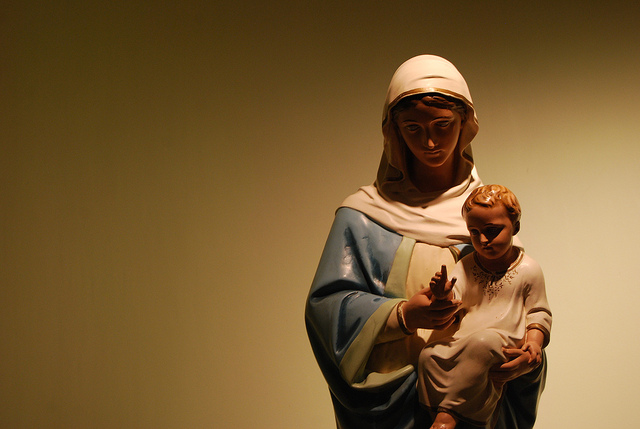
I remember reading a long time ago, before I ever had my own children, that people love the idea of mother. They love the Madonna cradling a serene baby Jesus. They love a statue mother.
People don’t want to have to witness the time when the baby cried uncontrollably or when the mother wanted to tear her hair out in frustration.
It doesn’t get more real than motherhood, though.
It doesn’t get more real than sleepless nights that are not going to be solved by some crappy online article about “ten things to do for a great night sleep!”
It doesn’t get more real than feeding issues and milestone markers and endless laundry and never getting to go to the bathroom alone.
We idealize motherhood so much that even actual mothers forget that there is no such thing as this.
This doesn’t mean we can’t try.
This doesn’t mean I won’t bite my tongue or consciously take deep breaths when I feel my own frustration level rising.
This doesn’t mean we can’t love our children perfectly, despite our lack of perfection.
I never thought I could love a human being as much as I do my children. I look at them and they are enough—my life has real meaning because I bore them. This is not the same as feeling fulfilled as a person because I’m a mom.
And this is why some days I want to go on vacation—I want just one day off.
There are no days off from motherhood.
There is an hour and a half at the yoga studio; there is that weekend I actually flew out to Connecticut to spend time with friends—but there is never a moment of my life when I am not a mother, and I’m sure that this will be true when my children are much older than I am as I write this now.
So I clickity-clack on my laptop for ten minutes while I attempt one more time to nap the restless baby.
I hit “save” and check on the oldest as she relaxes with a book.
And I look over at the baby monitor and see that she’s finally drifting off to sleep, and I again feel ready to do puzzles with my big kid for the billionth time.
Most importantly, I choose to stifle that inner critic and nurture the inner child—I choose kindness over fearful judgment because if there’s one thing I want to do perfectly with my kids, it’s make them feel safe by my love.
Love feels safe when there is acceptance—and I accept that I might never be the perfect Madonna-like mom, but I can be the perfect me.
Photo: Flickr/Mary.
The post A Picture Perfect Motherhood. first appeared on Jennifer S. White.
]]>The post The Caged Girls: Flying Above the Storm. first appeared on Jennifer S. White.
]]>
Visit here for more of The Caged Girls.
Chapter 29.
My pen rolls across the paper—fluidly—and my words come out almost sloppily. (It’s not my usual, preferred ballpoint pen.)
My fingerprint-laden aviator sunglasses—the ones I’ve had for nearly a decade, with gold rims and the lenses that make the world appear brighter—rest in the cup-holder next to me, to my left.
The warmed car seat beneath my thick, off-white winter peacoat helps me to relax.
My rose gold and turquoise ring—a family piece that’s circulated within us for over 100 years—falls slightly to the right as my thumb and first two fingers press into the firm rubber grip of the black pen, gliding smoothly along my decomposition book.
My cheek itches suddenly and I pull down the mirrored visor to look.
Distracted, I notice the way my dark brown hair wisps out of the copper barrettes that pull it back on either side, creating a few haphazard chunks around my temples.
My forehead has maybe three shallow lines running across, broken in the middle and making it, more accurately, six.
My fine eyebrows arch high and I admire the perfection of their shape (thanks to a recent salon visit).
My eyes have light imprints of sleep-deprivation underneath them that appear somewhat like purple-tinted shadows. Above these shadows, I observe that today my eyes are more blue than green. This changes easily, though—due supposedly to my black Irish ancestry—and I trace the yellow that faintly edges my pupils, lending to this color changeability.
I hear the trunk pop open and smile intuitively at the sound of my husband returning to our little silver Jetta.
I feel the soft, grey light hit the surfaces of the car interior and I hear, once again, the sound of my daughter’s music playing through the speakers. I’m no longer alone inside of my mind and, although it takes me a moment to collect myself and shake free from my thought stream, I smile again; knowing that life isn’t meant to be continuously lived inside of ourselves.
He climbs into the driver’s seat and reaches for my hand. After squeezing it between his much larger thumb and forefinger he pulls away from the two, diagonal yellow lines—and towards the pink and peach setting sun.
Chapter 30.
My fluttering heart stopped beating.
At least it felt that way—time standing still and you swear that you can see a humming bird stopped, mid-flight over your shoulder.
And then it ends and time starts up again, but it’s still slower for you—making the speed of the world overwhelming in its unnecessarily rushed and hurried pace.
When something stops you in your tracks—a loss, horrible news, a heart-cutting blow—it doesn’t seem fair that life shouldn’t pause while we grieve and figure out how to collect ourselves in order to stand back up.
These incongruous places in life can feel hollow and desperately alone—and it’s when we feel hollow and alone that anorexia can become an unfortunately welcome friend.
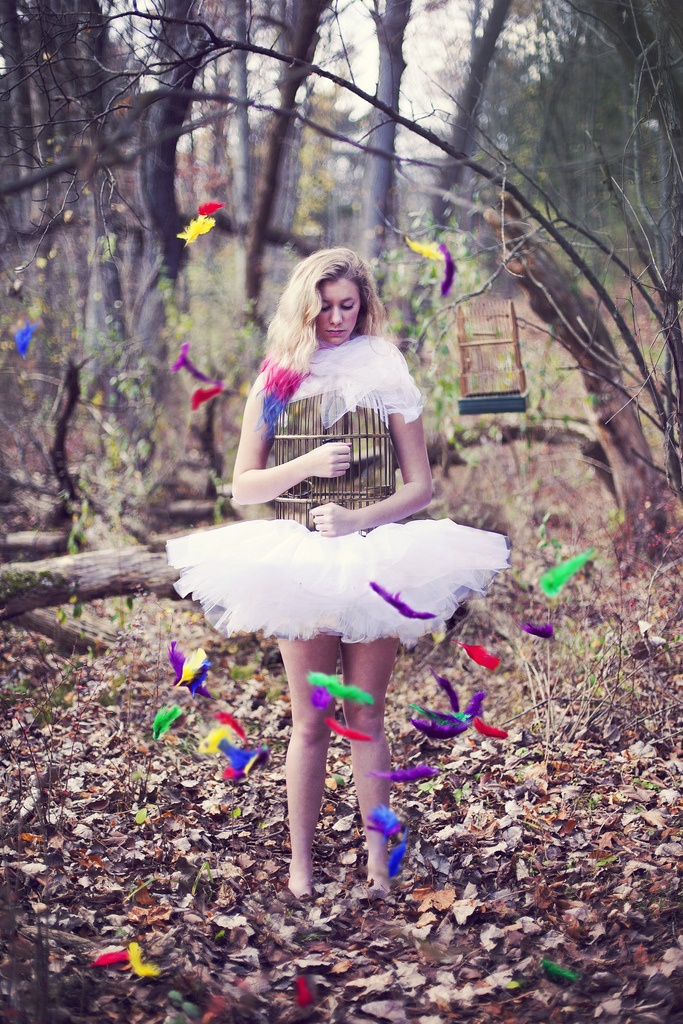
But anorexia is absolutely a frenemy—not a true friend. It doesn’t make hardships easier to deal with—it adds on to them; it becomes a distraction and, if we’re being honest, this is what we’re really seeking.
So, although I’m that rare once-anorexic bird who is completely recovered, I have to pay careful attention to myself—and to my heartbeat—when life deals me merciless challenges—because I know that I’m not immune from turning to an eating disorder to cope—no, I’m much more likely, considering that this is exactly what I did for years.
And there’s another cutesie saying that occasionally floats around the internet and pisses me off: fat is not a feeling. Because fat is absolutely a feeling—with an eating disordered person, that’s a perfect description of what it is.
And when, finally, we are ready to move forward from this night-terror of a coping mechanism—to begin picking up our pieces and moving a tiny bit closer towards our healing—we first need to admit what emotions we’re avoiding by feeling fat instead.
Anxiety?
Depression.
Loneliness?
Fear.
What is it that’s going on within the framework of our lives that we are trying so hard to avoid that it’s easier to abuse our bodies? (Note: this is where therapy can be helpful, within these early stages of the healing process.)
For me, I’m usually avoiding something that’s severely upsetting and that I’m not in control of—a situation with a family member, an illness, a death—and my eating disorder gives me that wonderful, false semblance of control.
More, it gives me something else to focus my mind and emotions on—my caged, needy body.
Chapter 31.
My fingers work clear, thick shampoo through my hair.
I close tear-rimmed eyes as white lather spills down my back.
Warm—almost hot—water runs down the length of my body, to my feet and down the drain near my toes—and I wordlessly beg for it to wash away anything that I don’t want to hold onto anymore.
I don’t want my guilt. The soapy water can have the fragments of my broken heart too.
I’m also ready to leave behind my anal-retentive need for authority—that piece of me that wants every minute, self-created element to fall in line with a cruelly fictitious plan that’s never played out correctly anyways.
Because I’m not in control—not wholly. Rather, I’m in control of the way that I react.
I’m in charge, also, of my actions. (Which reminds me of a few other things that I’d like the hot water to wash down this drain).
My fingers today don’t clickity-clack, clickity-clack. No, they sound more like pitter-patter, pitter-patter—light and not aggressive; softly hesitant.
Because I don’t mind sharing my intimate feelings—I want to explain how I broke out of my cage and how I don’t even keep it on my shelf for rainy days anymore—yet this doesn’t mean that I always love revisiting my past.
And that’s the strangest part about no longer being a caged girl, like my former self—the one who lived, at times, small and contented and, in others, angry and hostile—she doesn’t feel like me anymore. And when I step back in time and put on her fragile glass slippers and wear them around to see how well they fit now, I discover that, like Cinderella, they’re still perfect, and it scares me more than anything—the reality that I really was her and that she’s not just some character in a story.
Pitter-patter, pitter-patter—I want to tell her that she’s no longer welcome in my home with the sunny, open windows, but I know better—she’s more likely to come snooping—peeping—around if I ban her from my heart.
So I content myself, now, with those, thankfully, rare occasions when my heart stops beating and I can count how many times a hummingbird’s wings beat up and down, up and down, and I content myself, too, with my more reckless emotions and my upsetting human struggles, because it’s when I ignore them that she threatens to move back in—and I like my free—albeit humanly imperfect—life.
And I might not be able to stop my churning heart, nor the busied world from stalling, but I can count the pulsing of my own wings—I can feel the pumping of my reality and I can accept it, even when it doesn’t ideally mirror my quietly quaking soul.

Photo credits: tanahelene/Flickr; Geraint Rowland/Flickr.
The post The Caged Girls: Flying Above the Storm. first appeared on Jennifer S. White.
]]>The post The Caged Girls: A Billion Steps Back—How to Trust Enough to Fail. first appeared on Jennifer S. White.
]]>Part Eight of The Caged Girls: A Billion Steps Back—How to Trust Enough to Fail (Chapters 25-28).
Chapter 25.
I decided to overcome my eating disorder once and for all because I wanted to get pregnant, and I had no desire to pass along my terribly unhealthy relationships with food and my body to a child.
This is not to shame, blame or guilt any mother who suffers; this is a reality of our world—living in cold, dark cages and not being able to get out, even when we’re raising children—even when we’re raising daughters.
Still, it wasn’t an entirely unselfish decision, my desire to be rid of my anorexia before expecting a baby.
For one, I longed to cherish, adore, welcome and be admirable of my growing body, not disgusted by it. I’ve known far too many women who were hung up on the pounds gained and where and how their bodies changed rather than focusing on the fact that we’re forming a new life!
And yet the first time around, when I was pregnant with my daughter, I pushed myself to exercise when I didn’t feel like it and I ate like a homegrown picture of perfection—although I did enjoy myself and my garden-produced food—but I didn’t let myself truly relax into my pregnancy.
I don’t regret it either—giving birth is the ultimate exercise. (My abs were sore with lactic acid build up for days afterwards.) I gave birth naturally—never having so much as a Tylenol during my pregnancy or her delivery—and when I see women letting themselves get horribly out of shape and eating like anything but the health warriors that their bodies are calling on them to be, I feel sad and I can’t help but wonder how that labor will go.
But we can’t see the future—complications happen, plain and simple—but what about the ones that we can prevent or help to ease along?
My body is a machine; my body is also my cozy, warm, quiet, safe home—my body is both of these things and I wanted to figure out how to treat it equally in these two regards.
Let me admit, this is not easy. We’re conditioned to think in one way or the other—our physical selves as round, supple, womanly places of worship or as rigid, muscle-rippled, health machines. So what I’m asking—and what I asked of myself—is why can’t we be both?
Why can’t we have our cake and eat it to?
So I set on a long, arduous road of keeping ice cream in the freezer but not eating it—or, more importantly, even wanting it—every evening.
I set out to exercise and keep my body in top shape, but not to the point of obsession or ruthlessness with myself. And this is what I learned: when we go to either of these extremes—shunning our bodies as health machines or accepting them in full as such—we are avoiding who we really are.
We’re avoiding our fear or our hurt or our life in a multitude of ways when we don’t allow ourselves to sit still and eat something for the pure sake of flavor; instead heading to the gym or for a walk outside for the second time that day (or third, or fourth, or fifth).
Simultaneously, we’re avoiding our primal need to be strong and to be able to endure life when we sit around and avoid exercise because sweating in a yoga class might mess up our hair or make us have to shower again.
In short, we can’t be recovered from an eating disorder until we learn to accept these extremes and then to couple them together into softer versions. I know this is a huge claim, but I’m standing fully on it—because it’s true.
Chapter 26.
I see so many women claiming recovery when they’ve basically lapsed and gone the other way.
For example, if bulimic, there’s a sense of pride in being able to portion food with extreme amounts of care—and control.
If anorexic, there’s a sense of intellectual fulfillment in watching the scale tip the other way and in eating things previously deemed “off limits.”
What I’ve also witnessed is how these behaviors then usually go to an unhealthy extreme too, causing a set-back or a full-on relapse.
Because part of the life of a recovering eating disordered person is taking five billion steps back for every step forward—and it’s more frustrating than it sounds, which is why many people just give up.
What I’m telling you is this: don’t give up.
The world is filled with people who want to jump and leap and soar forward without ever going backwards—and this is not success; this is not the path to success.
Every successful person out there will tell you that learning to accept failure and defeat is an absolute must if you plan on being a champion in whatever it is you seek. You have to invite failure, actually.
When I started keeping ice cream in the freezer (in—gasp!—quart-sized containers) I would eat so much that I would feel sick to my stomach, but I knew that I had to continue keeping it there, because if I took it away and vowed to never eat ice cream again—as I had cyclically done for years—then I would never learn how to have only a little; that I would never truly heal because much of healing is trust and much of self-love is self-trust.
We’re animals and we’re programmed for feast or famine. I see this even in my daughter.
If she knows that she can have something tomorrow, she’s more satisfied to have only a little bit today, but if I take it away and ban it, then she wants to hoard it when it’s around. (Not that our kids can always choose their diets and portions, but this type of behavior is learned early on.)
And by this type of behavior I mean, partially, learning what’s a “bad” food or a “good” one, rather than keeping foods as merely what they are and discovering that we simply feel better when we consume more of this and some of that in moderation.
But the anorexic and the bulimic don’t know moderation anymore—they’ve programmed themselves into only an extreme and they inhabit entirely that land of do’s and do not’s and of famished and of bursting.
And we’re using food control or lack of control to equal out our emotional selves—which is why we first need to take emotional attachments and judgments like “bad” and “good” away from food.
Chapter 27.
The first time I publicly acknowledged my eating disorder was in an article for elephant journal titled “How to Overcome an Eating Disorder in 6 Steps.”
In it I detailed and defined six critical steps towards recovery.
What interested me was the amount of positive feedback that I received and how many views it got from readers, but how little it was shared.
It interested me because people don’t want to “share” their eating disorder on Facebook. Nope, they want to share a cutesie photo of desert at a gourmet restaurant or a picture of themselves rocking out a fancy-looking yoga pose, which is definitely understandable. People don’t want to place the ugly and stigmatized parts of themselves in public, to be dissected and possibly discriminated against for it later.
And there’s nothing wrong with this—but we’ve become a culture of either over-sharing or over-sharing phoniness.
And it was after the publication of this particular piece that I decided what my writing genre would officially be: writing about—and then publishing—what people need and want to hear but are too afraid to outright admit and ask for.
Chapter 28.
How to Overcome an Eating Disorder in 6 Steps—yes, this bold title was meant to lure people in, but it’s bold because I believe in this process, not because I’m trying to become clickable in an already click-saturated online sphere.
And here’s what I subtitled that blog:
Or, rather, how I overcame mine.
And my six steps of recovery look like this:
1. See food as medicine. On your quest towards leaving your food-is-the-enemy mentality behind, see food as medicine. After all, food nourishes your body in a way that nothing else can; it is medicinal. As a foodie, I totally get that food is so much more than this; it nourishes so much more of us than just our bodies. Yet someone with a severe eating disorder is likely incapable, at least at first, of understanding this. Trying to get them to see food as love or anything spiritual or special is beyond the scope of reality. Hopefully this will come with time and healing, but focus first on not seeing food as something to fear.
2. Eat when you’re hungry, stop when you’re full. It’s not just the people with eating disorders who have stopped listening to their bodies. Our society as a whole does not prepare us for a life of eating when hungry and stopping when full. I’m not only talking about the clean plate club either. I’m talking about that one hour you have to eat lunch or that window of opportunity to give your kids breakfast before school. I’m talking about the no you can’t have that before dinner rule. Let me tell you, it took literally years to re-learn my body’s hunger queues, and at times I had to quite seriously fight my bosses to eat when I needed to (I won). This reconditioning takes patience and practice—and, trust me, it’s worth it.
3. Stop using the F-word! Fat. It’s become an ordinary part of our lexicon—and this sickens me. I don’t believe in saying never, but I will tell you that I will never call myself fat again—especially in front of my daughter. Please, even if you think it, stop saying it. Not only are you allowing the cycle to continue for your kids, you’re allowing it to continue for yourself. Ever heard the concept that thoughts become words and words become actions? There is something real in this. Sometimes we have to fake it to make it, so I’m begging you to stop using the f-word.
4. You always have the potential to become sick again. I was severely eating disordered for well over a decade, for definitely half of my life thus far. Yet I don’t see myself as eating disordered at all anymore. Ask anyone who knows and loves me; I love food and I eat extremely healthfully, yet I still eat what I want when I want (and I don’t over exercise anymore either). But you know what? Some of my absolute worst periods came after I had mentally declared myself eating disorder free. Then it dawned on me that I’m more like an alcoholic: I can be recovered, but I’ll always have an eating disorder. Maybe you don’t agree with this philosophy, and this might not be true for people that haven’t been severely ill with this disease, but I fully believe that seeing myself as having the potential for a relapse is what’s kept me well for the last decade. Sure, there’s some negativity behind this, but it’s the harsh reality for some.
5. Treat yourself like a beloved friend. In some cases this might not work, because some people don’t know how to treat other people with love and compassion. However, this step really helped me. I first read about this concept—talking to yourself like a dear friend—in a book during college. Would you say some of the things you say to yourself to someone you really loved, or would you treat them with more understanding and forgiveness? Being objective in this loving manner is a huge step towards the ultimate goal of health and self-love. (And this is true for everyone, not just people suffering from an eating disorder.) Remember that thoughts become words and words become actions—so start demanding that your inner voice speaks more gently.
6. Practice yoga. If you already practice yoga, great. If you don’t, start. Granted I had been practicing yoga for years—as a stretching routine after a run or weight lifting session. However, when I finally tuned into a daily yoga practice, I discovered so much health and ease and love for myself and for my body. Practicing yoga has helped me overcome a myriad of physical problems—from chronic low blood pressure to SI joint pain after childbirth—and you know what? I credit it for saving the real me that had to live inside a sick person. So thank you, yoga.
If these steps seem too easy to be true, it’s because they are. Just like anything else, you can be shown how to do something but it takes your own work and practice to be successful.
Recovering from an eating disorder is possible.
For many years, I defined myself as an eating disordered person first, who happened to have other qualities. Now it’s not even part of my vocabulary, much less my self-definition—and it took many years and many setbacks to achieve this.
So how do you overcome an eating disorder? One small step at a time.
Photo credits: Author’s own.
The post The Caged Girls: A Billion Steps Back—How to Trust Enough to Fail. first appeared on Jennifer S. White.
]]>The post Life (& Happiness) Happen When We Make Other Plans (& Stop Aiming for Perfection). first appeared on Jennifer S. White.
]]>
Well, today didn’t exactly go as planned.
My not-feeling-so-hot daughter stayed home from school this morning, nixing my own plans.
This isn’t the biggest deal. Rather, it’s more of a stringing series of happenings that seems to be building upon one another regularly—and haphazardly—much like the Legos that she and I played with yesterday.
 (
(So, that happened.
It was awesome.
I digress.
Here’s what didn’t happen: a visit I was looking forward to, a yoga class my body needed—and that my spirit needed more—and, most importantly, a mother’s heart is never truly at ease when her child is out of sorts.
And yet.
And yet the two of us aren’t usually the kind to mope—or mope for too long.
Instead, we might be putting NPR’s Tiny Desk Concert out of business with our own Tiny Bathtub Concert series. We broke out the hairbrushes and the combs and, essentially, anything that could serve as water-friendly microphones.
We listened to all of the songs on this playlist plus a few more from this one.
Then we had bathtub snacks and beverages, of course.
But better than Legos, hairbrush microphones, bathtub bubbles and favorite music was the fact that, for the first time in two days, I stopped crying.
I’ve been excessively and unusually weepy—and I don’t think that’s a bad thing. Sincerely. It’s me getting in touch with my reality.
Because I’m not perfect. (Although I am perfectly imperfect.)
I have gloriously lofty ideologies, but I will forever make mistakes, and, thankfully, plenty of them.
Because I don’t want to be perfect—that’s boring.
I don’t want to always be good, wholesome, happy and anything else that’s pretty to write about—or read, for that matter.
What I do want to be is this:
Honest.
I want to live my life from a place of genuineness, even if that means that I’m open with my missteps and errant ways.
Still, I don’t want to be open and honest if it means not being kind.
Honesty that deeply hurts another should be questioned adamantly.
Improper.
I don’t want to live in Downton Abbey, although it would be nice to visit.
Sure, I love the clothes and the characters are a fascinating collage of personalities, but it’s—how do I put this—a little too stuffy for me.
I don’t want appropriate at the expense of enjoyment of life.
Permanently idle, no—but capable of being idle, yes.
Yes. Yes. Yes.
Movement can sometimes be an escapist means of denial.
To sit in my discomfort, when it arises, is to know myself, and to know myself breeds wisdom and, potentially, a better understanding of those around me as well—and that I want. (Plus, we all need balance and part of balance includes rest.)
Does this mean that I don’t try my damnedest every day to be a wonderfully good and wholesome creature? No—but there’s also a striking difference between intentions, aims and end results.
Much like my day not going as planned, life doesn’t—overall—typically go as scheduled and, further, because of these unexpected detours, we become the people who we are.
And I like me.
I like my sassy tongue–even if that means I’m occasionally a touch too sharp with it.
I like that I’ll never be able to spell occasionally without thinking about it—it means that I’m human.
And I like my daughter’s quirks—they’re, strangely, often her most pleasant talents.
I like, too, the days when my child and I are snowed in or that we’re home not feeling our most amazing—because this is when those little snippets of life happen that bring me the greatest, most genuine, most honest, least expected joys—and that’s why I stopped crying, finally.
After all, there will be plenty of school days and plenty of yoga classes, but there won’t always be days when I have a three year old who wants to sing with me into our toothbrushes in the bathtub—or maybe, just maybe, this will, likewise, be different than I suspect.
Photos: Author’s own.
The post Life (& Happiness) Happen When We Make Other Plans (& Stop Aiming for Perfection). first appeared on Jennifer S. White.
]]>