The post How to Be Your Own Rainbow. {The Caged Girls} first appeared on Jennifer S. White.
]]>
Chapter 41.
She sat at her nicked, antique dining table clickity-clacking on her laptop.
The sky wasn’t dark, yet rain fell steadily.
Her favorite mug, the pink one with Dorothy’s ruby slippers, sat next to her.
This morning her heart felt like grief. The feeling surprised her and was strangely welcome too.
It felt like years of painful sorrow rising to the surface of the skin between and above her heavy, pregnant breasts and beneath her sharp collar bones. It felt so close to a lump in the throat that leads to steady streams of tears, that she almost disbelieved her pain wasn’t visible to anyone else.
What was most unusual about this particular sensation of grief wasn’t the sureness and suddenness with which it rose, but the overall feeling of pure elation that she also felt.
She felt joy in her belly, like a fire around her hips and up to her naval. She felt happiness at the tip of her tongue and within her glowing blue eyes. She was completely filled with joyfulness that didn’t have a particular reason or an easy explanation. And still, she felt the grief.
The green world outside her large front picture window, where she types, echoes her own internal sensations; the brightly lit sky and the dumping cloud water.
She went to yoga class today.
She almost didn’t go.
She almost stayed home and didn’t do anything in particular while her daughter was in school for two hours, but she knew she should, so she went.
It wasn’t until after a sweaty class, with music pumping and a friend next to her purple mat, that she got into her car and realized that the grief was gone—she’d sweated and moved it away.
Movement for the body is like wind for rain clouds. The sky can clear while the weather moves away from overtop the house on the hill, leaving only sunshine and wet reminders of its wake.
Similarly, unwanted feelings and old, buried burdens can pop up like shocking storm fronts, causing either chaos or delightful relief from something long-over due.
But the garden doesn’t collapse from the strong rain. Instead it’s drenched and fueled to grow. Likewise, the human heart is naturally meant to survive.
We can live in survival mode for years, sometimes without even realizing that we’re there, not really living. And then the sky clears, and the rain isn’t gone, but it lessens and we observe the end of our storm—or the beginning of an ending—and we’re able to recognize what we’ve gained through the downpour.
We’ve gained fortitude. We know that we can make it through something we couldn’t have imagined a red heart still beating after.
And we remember also what it’s like to do more than just survive.
We stretch and reach towards the sunshine that begins to creep along our skin. We recognize that we’re open to letting light back in—open to joy and happiness and love.
And the clouds begin to separate into fragments instead of one black mass and the color brightens within every cell of our being as we move towards something more than our falsely protective jail of survival.
And, for me, physically moving my body—letting sweat glisten and drip and slippery hands slide on my purple rubber yoga mat—has always helped me to see a possibility of an ending to a long, long rain—more, it helps me create one.
So I sat cross-legged next to my friend in yoga class.
My teacher’s previous words that we store “our issues in our tissues” echoed within the caverns of my ears.
And as I bowed my forehead towards my prayer-positioned hands, I honored the storm that had passed through me that morning; that threatened to rock my day, my mood and my deepest self through invisible memories of experiences I’ve already lived through—survived through—and that, frankly, I don’t want to go through again.
I honored, too, the people around me and their own secret-yet-obvious-in-their-own-hearts wounds, and I sent out my new, loving rainbow that this too shall pass for them and for all of us.
This too shall pass—but sometimes it takes our own animated desire to say good-bye.
Visit here for more excerpts from The Caged Girls.
Photo: tsaiproject/Flickr.
The post How to Be Your Own Rainbow. {The Caged Girls} first appeared on Jennifer S. White.
]]>The post How to Live With a Hole in Your Chest. {The Caged Girls} first appeared on Jennifer S. White.
]]>
Chapter 40.
The imprints of some experiences stay with us forever.
They swim around and around in our subconscious mind like something stuck permanently going down the bathtub drain.
One of these such memories is the worst evening of her life.
She lies on a hospital cot curled up in a ball thinking that she couldn’t, for the first time, get back up to standing from this fall.
Her newborn lay in a cold, clear isolette. No parent who hasn’t gone through this will ever understand.
They’ll never understand the fear, the cold-blooded fear, that runs through chilled veins when a child may or may not thrive into infancy, although just its imagining will turn any parental stomach.
She saw many other faces in the NICU. She rarely saw other parents.
At first, she couldn’t understand; couldn’t fathom where everyone was when all that was worth living for was within the confines of this seemingly sterile jail cell.
But as time wore on she figured it out.
They were out working. They were caring for older children. Because many of these babies were here for much longer than her own few-days stay, and some would never leave.
They had to transfer rooms when theirs would be turned into a mourning room for a family that would surely be grieving by that evening.
She could hear stifled cries through the walls and, for once, she saw the same faces regularly, but now she wished she wasn’t.
She drank kefir from a brown bag filled with her favorite foods and kept in the lobby refrigerator. She hadn’t cared about food at all, but her midwife did and had brought her everything she loved to eat.
The sobs and cries and chest-beating howls that she wanted to let loose sometimes dripped slowly down her cheeks—silently, wordlessly, showing the bleeding of her wounded mother’s breast—but, more often than not, she became the stiff, lifeless person that she inhabits when truly and deeply affected.
She’s angry—a fierce, fearful anger leaps from her body when motivated—but when something intertwines a barb within her soul, be it from emotional pain or a wound so deep that it could potentially be fatal, she closes down. She’s always been like this.
Her gaze falls on her newborn in the clear isolette, who she’s learned will be okay.
Yet somewhere in the space of the passing days, she’s pulled back from being a mother.
It’s hard to touch someone who’s hooked up to machinery and it’s even more challenging to begin to love someone who you might have to let go of before you’ve really begun to hold on.
She remembers the shock that came with the sudden realization that her daughter was in danger; the shock of recognizing completely that she loved someone more than she’d ever experienced before and they’d only just met hours previously.
Tears come to her eyes, even now, but she still won’t let them flow.
She feels a slight flutter in her lower abdomen where another baby grows—a sibling for the child once in a clear, cold isolette—and she knows that her maternal soul is already tearing open before her skin has; before she has even given birth.
She pauses and drinks in a quiet morning breath with her eyes closed, her empty coffee mug sitting on the wooden floor next to her bed where her fingers clickity-clack, clickity-clack across her laptop keyboard.
And she did make it through. She did live. But she knows, too, that there’s a gaping, oozing hole in the center of her chest that will never, ever heal.
And the sometimes stifling reality is that we’re all walking around with holes in our chests.
Beating, injured flesh-made hearts that continue to pump and live and feel because, amazingly, the smallest token of genuine love can begin to create tender scar tissue over nearly any wound.
Her baby suckled at her breast, looking up into new mother’s eyes, and she let herself warm to the gentle sounds of coos and giggles emanating from the tiny being cradled nearest to her heart.
Visit here for more excerpts from The Caged Girls.
Photo credit: Adam Jones/Flickr.
The post How to Live With a Hole in Your Chest. {The Caged Girls} first appeared on Jennifer S. White.
]]>The post The Caged Girls: Jennifer’s Body. first appeared on Jennifer S. White.
]]>
Chapter 39.
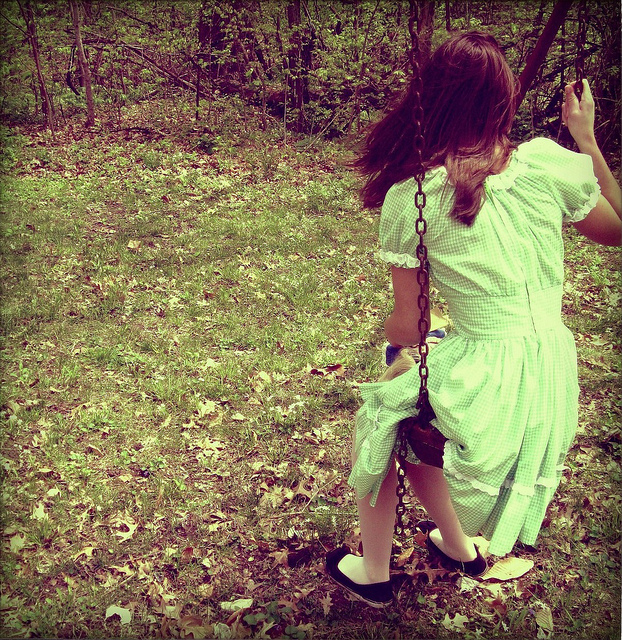
Small flutters of movement ignite her lower abdomen.
She’s thrilled to, with no doubt in her pregnant being, finally feel her baby move.
Little invisible swimming motions stop her thoughts throughout the day. She’s brought instantly back into the awareness that she undoubtedly shares herself with someone else—someone she hasn’t yet met; someone who now holds her heart in a tiny, palm-sized frame.
She stepped onto her yoga mat but had trouble being in the room today.
The class, for her, felt off and her body felt tense because of it. Her breath didn’t flow freely and she had to remind herself to finish her exhales—something she rarely has to do anymore.
These past few months marked nine years of daily yoga practice, much of it on her sticky mat. Nine years of gaining strength and flexibility of mind and, consequently, of her body too.
She practiced yoga for more than nine years—for well over a decade, actually—before her daily routine took shape, but they were fairly shallow. Contrarily, though, she’s been practicing yoga for years without realizing it.
Every time that she put one tennis shoe-clad foot in front of the other on a hiking trail; when she reclined curled up in the nook of her boyfriend’s shoulder in sticky, summer grass gazing up at evening stars; each instance that she acknowledged what she felt, however uncomfortable, and let that emotion roll by, crest and fall, she practiced yoga without a yoga mat or expensive pants or even a specific agenda in mind.
However, she’s discovered that the easiest way to get to this place of stillness—of quiet ease—within her mind, and deep within her bones, is on her purple sticky mat.
Going to class is typically an efficient tool for her to relieve herself of her swirling, churning brain and her deceptively complicated heart.
She feels a flutter in her belly again—this sensation is becoming familiar, expected and desired.
In the background, her daughter climbs on the television stand like it’s a jungle gym and then, for a few breaths, sits perched upon the top shelf watching a kids’ show on PBS before climbing back down and then up again.
She tilts her head and looks at the gold “G” emblemized on a ring on her first finger. It turns slightly, until the “G” sits off to the side. The stones of her family heirloom fourth-finger ring stay perfectly still despite her fingertips moving rapidly across her black keyboard.
Momentarily, she closes her eyes and breathes in; sucking air like a vacuum into her lungs, slowly purging it after a brief pause.
Spaces like this that exist in life—these insufficient nothings that are seemingly both inconsequential and lacking in depth—are, ironically, the beats that make up the rhythms of our lives. These are the words that we leave out, and their absence makes the sentence fuller.
Life is funny—we are funny.
We chase crescendos and, occasionally, even nadirs, but it’s these ellipsis that need to be given our attention.
She feels a flutter in her lower abdomen, and she closes her eyes once more…
Visit here for more of The Caged Girls.
Photo: Holly Lay/Flickr.
The post The Caged Girls: Jennifer’s Body. first appeared on Jennifer S. White.
]]>The post The Caged Girls: Saying Good-Bye to Yourself. first appeared on Jennifer S. White.
]]>
Chapter 38.
Her memories come to her in waves and flashes.
Sometimes they startle her in the middle of the night.
She sits up in bed, sweat soaking the back of her t-shirt and lining her neck, underneath her brown hair.
Others, she slowly creeps into a vision, long-held in her muscle fibers without her conscious knowledge. It seeps in and around her and carries her heart to another lifetime and, although hers, it frequently feels otherwise.
The first type of memory—the sudden ones—bring flashes of trauma and grief. The latter, however, bring her pity for a little girl or an old friend and it often takes a moment for her to recognize that her sorrowful empathy is actually—strangely—self-directed.
Yet, memories are like old friends themselves. They greet almost-forgotten spaces of hidden light and joy. They bring snapshots of happiness from a former lover (our own younger selves).
She pulls the blanket tightly around her shivering shoulders; clasping the tattered pink ends together in one hand between her bony clavicles, which are slightly uneven from scoliosis and being broken more than once.
She looks out her window at the smoky, hovering fog and the evenly spaced raindrops; reaching out of her blanketed nest with one chilled hand for her warm coffee mug, the one with the chip out of the corner that says Mommy needs coffee. Give mommy some sugar.
She sips slowly; feeling the velvety, slightly nutty taste roll over her tongue and then smoothly down her throat, but she’s not really there, drinking her coffee.
Instead, she’s sitting on her best friend’s bed after a night out together. They’re talking and telling each other how much it means to have a friend you can share anything with. The best friendships are like this one, too—when you don’t actually need words to round out these self-explaining sentences.
And then she’s in her boyfriend’s arms and he’s telling her how beautiful she is and, remarkably, she believes him.
She’s lying on the couch, fatigued from not eating much of anything that day. And she’s in her boyfriend’s bedroom so skeletal that the flesh hangs off her buttocks—it’s the only time in her always-changing girlhood body that he’s ever found her unattractive.
And then she’s in the birthing room telling her midwife that she can’t do it, although she nearly has.
And she’s standing beside her grandmother’s coffin with her broken teenage heart spilling into the wooden box along with her tears and then she’s mourning another teenager’s death in a high-ceiling church full of natural light and the heaviness of a grief too profound to either purge or bear.
She pulls the tattered pink blanket closer to her neck and takes a drink of coffee. She knows that she needs to be there, in that room, for every swallow.
She needs to feel the nubbly texture of her washed-a-billion-times pink fleece blanket against her skin.
She needs to remember that life is fragile and, alternately, that she’s never as delicate as she fears.
She places the worn, loved mug on the cracked chocolate leather ottoman in front of her.
She feels her arm muscles contract to place her hand back into her lap and she settles into this temporary space of quiet and solitude; of trickling rain and translucent vapor hovering above dewy ground.
She feels the breath flow in and out of her stuffed-up nostrils and she waves good-bye to that wandering girl who stopped by for an early morning visit; to have coffee with her and then to leave her with the inherited insight that life both contorts and transforms into something entirely new so quickly—so quietly and without an advanced warning.
She waves good-bye to her and then she turns, taking one modest step at a time into the lifting fog of her brand new day.
Photo credit: Author’s own.
Visit here for more of The Caged Girls.
The post The Caged Girls: Saying Good-Bye to Yourself. first appeared on Jennifer S. White.
]]>The post The Caged Girls: She is Reborn. first appeared on Jennifer S. White.
]]>
Chapter 36.
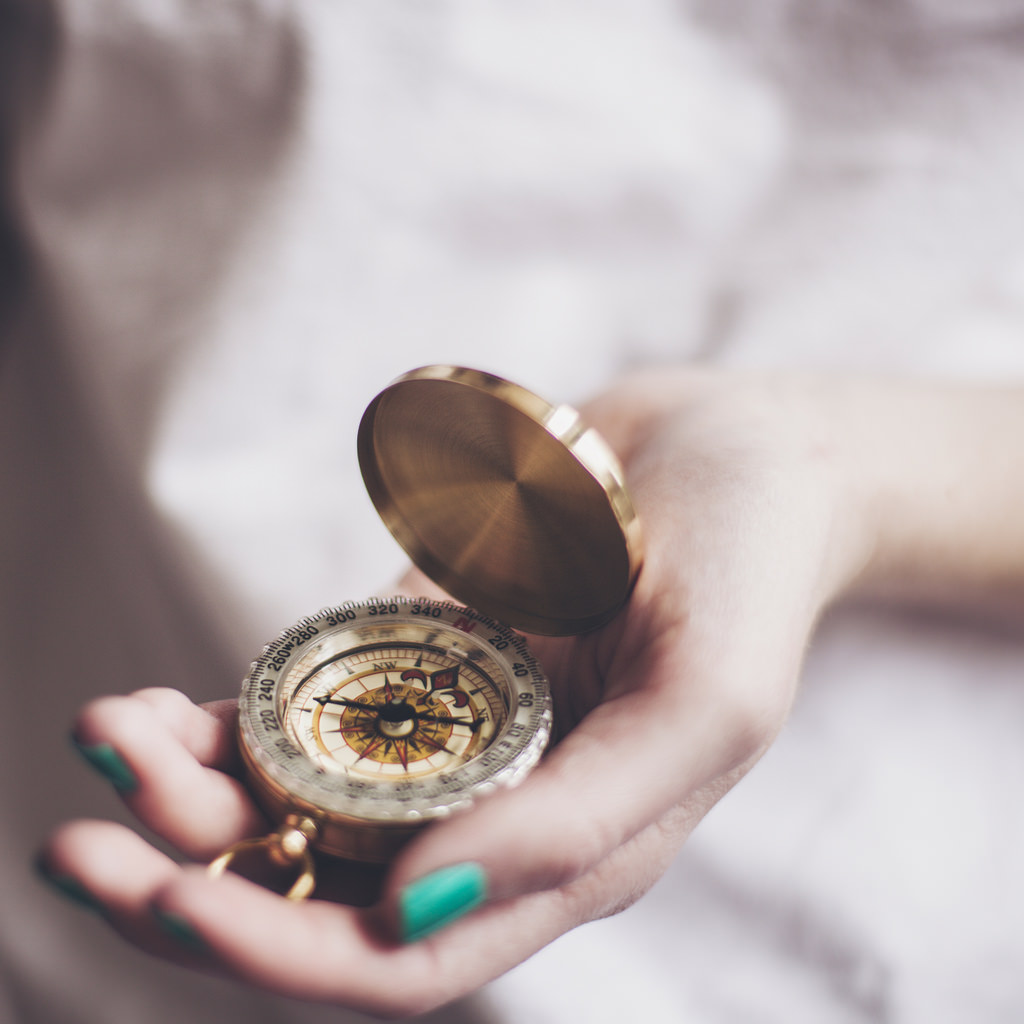
She sits in bed writing what lies inside her chest.
It spills out in bursts and pauses today rather than intense moments of clarity.
She’s had this nagging feeling that she can go in two different directions, not just physically, but mentally and emotionally as well.
She’s pregnant, with her second child. She feels life beginning within her and it quickens her heartbeat and slows her reactions.
She feels sluggish.
She’s at that gorgeous, initial starting point where the finish line is visible, yet not something that feels real.
Her heart knows that it can handle two children, but her daily patience and overall inability to occasionally deal with stress makes her slightly fearful.
She doesn’t like feeling afraid.
For a time, she simply shoved it deep down and played with her daughter and felt nauseous and the beginnings of roundness, and all that comes with impending motherhood. Now, though, she sits typing and she stops—and she listens. She listens for whatever it is her churning thoughts are trying tell her.
Chapter 37.
Her practice has periods of bursts and pauses too.
One week she goes to class four times and practices at home as well; still others, she finds herself stalled by a sick child or her own body.
The first time that she was expecting, she pushed through a variety of workouts, through teaching yoga classes and even through new, additional certifications. However, this time she’s promised herself that it will be different, and she’s heard this from many second-time mothers.
The first time we start out like puppies, ready to race and play and squirm underneath any obstacle, but with time, and with wisdom, we see the merit in being a little bit less like that notorious hare and more like the moral tortoise.
That’s not to say that she won’t push through workouts—although she has temporarily given up teaching in order to be at home; to practice, instead, being the kind of mother she dreams of becoming—but she’s committed herself to enjoying this slight stillness—as much calmness as can be had with a toddler running around—before another addition comes into their family.
She finds herself feeling unsure of this new equilibrium that she actively seeks out. She finds it ironic that passivity, for her at least, takes active work.
She hears the pitter-patter of her fingers and the slight click, click, click of her longer nails as she types and, suddenly, something blurts into her understanding:
She’s always effectively stilled her stream of consciousness by moving physically through her body and this is the pattern that she’s trying to change; to break; to disorder.
For the moment there’s only disorder—random mental chatter of her flaws and her failures. She remains determined, though, and not just for her sake, but for her family’s and for this life that’s growing quickly within her.
She hits “save” and her fingers momentarily rest; stop; still.
She’s not sure precisely why she needs to do this for herself—to back off and let things happen more naturally this time around—but it’s a gut instinct and, she’s learned the hard way, those you don’t ignore.
Photo credit: tanahelene on Flickr.
The post The Caged Girls: She is Reborn. first appeared on Jennifer S. White.
]]>The post The Caged Girls: We Practice to be Reborn. first appeared on Jennifer S. White.
]]>
Chapter 35.
There’s a fearful quiet that permeates when you do nothing.
The silence leaks into my bones and stills my clumsily racing heart—until I feel my heartbeat quicken, made uneasy by the restless thoughts that still churn beneath my tank-top covered breast. These thoughts aren’t bad or unwanted, just…unsettling.
I settle into this silence anyway; urging the quaking evident within me to rest (although I haven’t moved). Calm and steady, I appear—tired and empty is how I feel.
This house contains my family. Turned into a home by tiny smiles and small waving hands, saying “bye-bye” for no better reason than to hear her own voice. Clinks, clangs and chimes from metal stirring metal in the kitchen, where he works diligently, lovingly and efficiently to make another beautiful dinner for the three of us. And yet I feel alone.
It’s not that I truly feel alone—I know that I’m loved and, more, I know I’m safe and cared for. Still, there’s an aching and a longing within my slowly beating chest that pounds and pounds and thumps and thumps for the desire of something more than I’m getting at the moment.
I decide to begin a new book—not reading a new book, writing a new one. It’s time.
I feel how my words go on and on for days, but there’s something missing within them because the most important ones are being ignored.
I ignore these words and my next big work because I’m terrified that I won’t feel as connected to it as the first one that I penned; the one that I wrote for her and for her tiny hands. So procrastination in the form of other books and smaller things containing my ideas has filled this empty space instead of what should have, and for nothing more than insecurity.
I am not an insecure person.
I dream big and laugh even bigger and I love and live life with passion, humor and intensity. There’s something meaningless contained within it, though, because recently I’ve regularly failed to display this hidden well that continually bubbles up inside of me.
I regain awareness of where I am and I shift consciously into something significantly less conscious; returning to the stillness, and to the quiet.
It fills up this space and it makes me feel full. There’s a threat that comes along with fullness—I’m incredibly aware of that also—because sooner or later you know—I’ve learned—that it drains either slowly or suddenly like thepssssssss of a punctured balloon.
With eyelids unmoving—unblinking—I place my right hand on my heart.
Thump, thump, pound, pound.
I will the nagging worries of selfishness and lacking away, but they insist on coming back stronger because no matter how hard I have tried, I understand—I’ve learned this as well—that feelings shouldn’t be ignored—mistaken for letting go.
I know what letting go feels like.
It feels like shoulders softening, heart lifting, eyes welling up with tears.
It feels like fingers slacking, arms hugging, lips turned up at the corners.
It feels, too, like that irreverent enemy—quiet, fearful stillness—because letting go means that you’ve become empty in order to fill again, and you wait, but not patiently.
My right hand drifts down my supine body to settle upon a concave belly. I feel the angular protrusions of hip bones and vividly—yet briefly—remember how it felt to hold her—my unborn daughter—there.
What no one told me about having a child is that you don’t change that much—you’re still you, only now you add mother and full-time heart holder to your list of dutiful, hallowed roles.
Squeals and laughter shouts from down the hall. I envision the next room: he is tickling her and cuddling her and she’s beaming up into his grinning face. She calls for me and, although it was silent, I hear her loud and clear.
I turn to my right side and lie there for one long moment of letting go—heavy burdens slide down my back, roll onto the deep purple yoga where I recline and then drift out of sight; out of my small yoga space and (temporarily?) out of my life.
I carefully glide myself up to sit, placing hands in prayer in front of a steadier, dimly pacified heart.
Gently—gingerly—with soft palms easily pressed together, I trace them up to the center of my forehead and just as silently—and powerfully—as her voice called to me, I humbly answer Namaste.
Somehow within the silence, within the languid movements—and within this stillness and trickling breath ofsavasana—I have worked past fears, and even though they aren’t permanently conquered, I know that this is why I practice—to be reborn—and I feel grateful to be back on my mat.
Photo: Lauren Nelson/Flickr.
The post The Caged Girls: We Practice to be Reborn. first appeared on Jennifer S. White.
]]>The post The Caged Girls: She’s on Fire. first appeared on Jennifer S. White.
]]>
Chapter 32.
I can always tell when I’m just about to fall asleep.
I get this tingling sensation throughout my entire body.
It’s not uncomfortable or scary, but it’s distinct and something that occurs for me only before sleep.
I love it, actually, because I know I’m about to drift away…and rest…
Her heart felt muted by the colorful beauty that surrounded her. It was hard for her to tell whether or not she, too, possessed such miraculous shades of joy and vibrancy or if her typical dream-world state of grey was saturating her waking self too.
She dreams in shades of grey.
She knows that life is a palate of colors and shades and offerings—and choices.
She chooses life.
Over and over again she chooses it, even when it’s distressing in its grief and sorrow and it’s heavy with a profound sense of meaning that no one seems to agree upon.
We spend—no, we waste—waking hours and minutes and years arguing about what God is and about the best way to govern a country and a family. We tell other people how we’ve done it and how our way is special, although we often neglect to properly convey our mistakes and imperfections when we share our recipes for a life of overwhelming success.
So she decided to share her foibles—her flaws, her quirks—the things that make her human and that maker her special.
She wakes up before the sun, in the middle of a dream. She’s not sure, but she thinks she dreamt in color—fiery, dynamic visions that her mind came up with while she slumbered.
She rolls to one side and plants her feet squarely on the cold, hard wood floor. She sits, slightly slumped at her shoulders, for several beats before pressing up to stand and walking lazily to the bathroom.
She looks in the mirror, at her still tired face.
Her eyebrows aren’t smoothed down and she has a tiny patch of dry skin near the corner of her mouth. Fine wisps of hair stick out at nearly invisible angles around her jagged part-line .
She gazes steadily into her blue-green-yellow eyes and sees something—a spark.
She gains momentum as she hurries to the kitchen to make herself a cup of coffee and some toast with almond butter and honey. She takes her simple breakfast into her bedroom, where her busy fingers take this spark and ignite her thoughts and dreams and hopes into words that she wants others to share with her—that she wants to share with you.
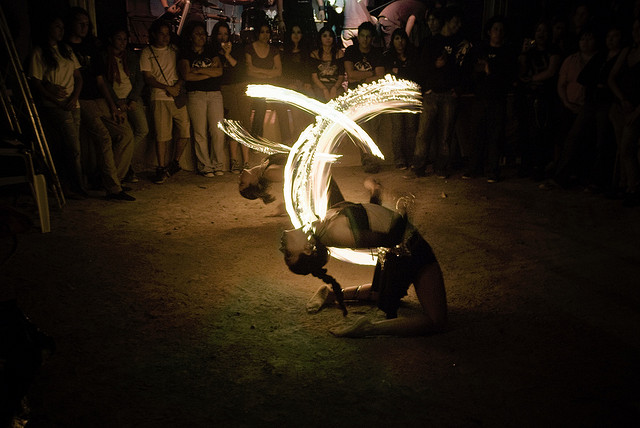
Because she has a feeling that it’s these tiny embers of raw, human blemishes that start fires that will change the world.
Photo: Eneas de Troya/Flickr.
The post The Caged Girls: She’s on Fire. first appeared on Jennifer S. White.
]]>