The post Throwing Away “To-Do Lists” to Make Memories. first appeared on Jennifer S. White.
]]>
It’s easy to move through parenthood with a mental “to-do” list.
To do: get child to school; feed, clothe, and bathe.
To-do: pay bills, go for allergy shots, buy wine, get some sleep, exercise—in short, function through life while also finding time to make love and go to the zoo.
Still, I have a feeling that I, like many, will eventually—at least in some small part—relate to that old “Cat’s In The Cradle” theme, where I—and possibly even my children—will lament the time not spent not checking things off of my list.
Because life is not a to-do list. Alternately, the things that we all generally want more of are simple: more love, more time, more peace of mind. These items, though, aren’t found on grocery store shelves—which is exactly why the “best things in life are free” saying is oh-so true.
Regardless, there’s a reason why we spend time putting the dishes away, and going to work and paying bills: it’s called the responsibility of being a grown-up, and this responsibility magnifies greatly after having children.
Today I almost unrolled my yoga mat for 20 minutes of Pilates. I debated, too, getting out my laptop to write. I had just put the baby down for a nap and her big sister was happy watching a show. In that instant of hesitation, however, I closed the hard grey plastic of my laptop, I didn’t give my sage green yoga mat another glance—and I asked my daughter to go outside.
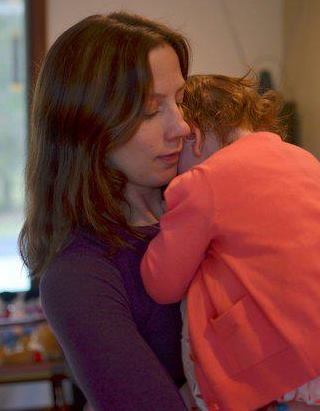
We took the baby monitor, her stuffed bunny and a favorite book onto the front porch. We sat in next-to-each-other chairs and watched cars go by on the road at the bottom of our hill. We sat and sang “Wheels on the Bus” (about 49 times) and we read Biscuit (about a dozen), and then she curled up onto my lap and we sat together in my white rocker, watching cars and making up songs.
We sat out there for well over an hour, but it seemed like 30 minutes.
At one point, this realization hit me square in the chest—where her head currently rested—that I almost missed this to get some work done, or to exercise, or to fulfill my “busy” mind.
Don’t get me wrong—we need to work. We also need to move our bodies. Moreover, we do these things as healthy, shining examples for our children, although they often seem and feel more self-indulgent.
The memories I retain from my own childhood are both firm and fragile—that foggy time I held my twin sister’s hand through our crib slats, or the hazy moment I played catch with my dad on the front lawn to break in my brand-new mitt. Our trips to Disney World were great, but it’s these ordinary moments cuddled up in rocking chairs that we latch onto, because children love—but don’t necessarily internally idolize—the grand gestures that we make as parents.
What I remember most firmly from my childhood is the way that people made me feel—do we make our kids feel loved?
Tomorrow, I might choose to unroll my yoga mat, because my body really needs the physical release.
I might write or take a “mommy timeout”—and I will try not to feel guilt over this, because self-care is paramount for our health and for the health of our relationships, including those that we foster with our children—but when my daughter wants to crawl in my lap with her Biscuit book yet again, and I’m torn between catching up on my email or Facebook or writing—anything that could possibly be saved for later—I’ll choose her as often as I’m able.
“And the cats in the cradle and the silver spoon…”
It’s a common refrain for a reason—we are moving through life as life demands: work, eat, pay bills, sleep.
I told my dad yesterday when he was visiting that on Fridays, when my daughter doesn’t have preschool, I’ve taken to napping the baby in the morning like usual and going into the playroom with my oldest for her current favorite activity, the coveted childhood tea party.
There, she makes me chocolate soup to the tune of my “ooo’s” and “aaah’s.” She shows me how she waits patiently when the food needs to be warmed up in the oven, or that she likes to squeeze a wooden lemon into her play Earl Grey. (I’m a coffee whore FYI.)
She uses words—like “Earl Grey”—that I didn’t even know she knew, and she shows me that she’s observing me as I go about my real-life activities—my real “to-do” list.
I feel I know my child better by slowing myself down and forcing myself to pay attention—to be present—when what would have been simplest would be rushing along through my “to-do’s”.”
I feel I know myself more.
And, at times like these when I want to skim over a tea party or mentally get ahead of my own day, I take a few slow inhales and exhales—like I’m showing her—and I stay here—with one more read through of a book so worn that I can barely turn its pages.
There are many, many times within my day when I perform a chore that I care for infinitely less than my child—that’s called life. There are many other instances when it’s my choice to hop on Facebook or color with my child or insert something super-productive or lazily-interesting here.
Sometimes, I just plop down in the middle of my living room floor between my two children. It’s interesting to see how they react. Usually they both run and collapse into my lap—because, as much as kids need hot food and clean sheets and money for school supplies, they need love.
Love is easy to forget about, if we don’t place it high up on that to-do list—and love is free and pretty to think about, but it’s, unfortunately, not always the easiest choice.
The post Throwing Away “To-Do Lists” to Make Memories. first appeared on Jennifer S. White.
]]>The post Why I Fell in Love with His Smile Lines. first appeared on Jennifer S. White.
]]>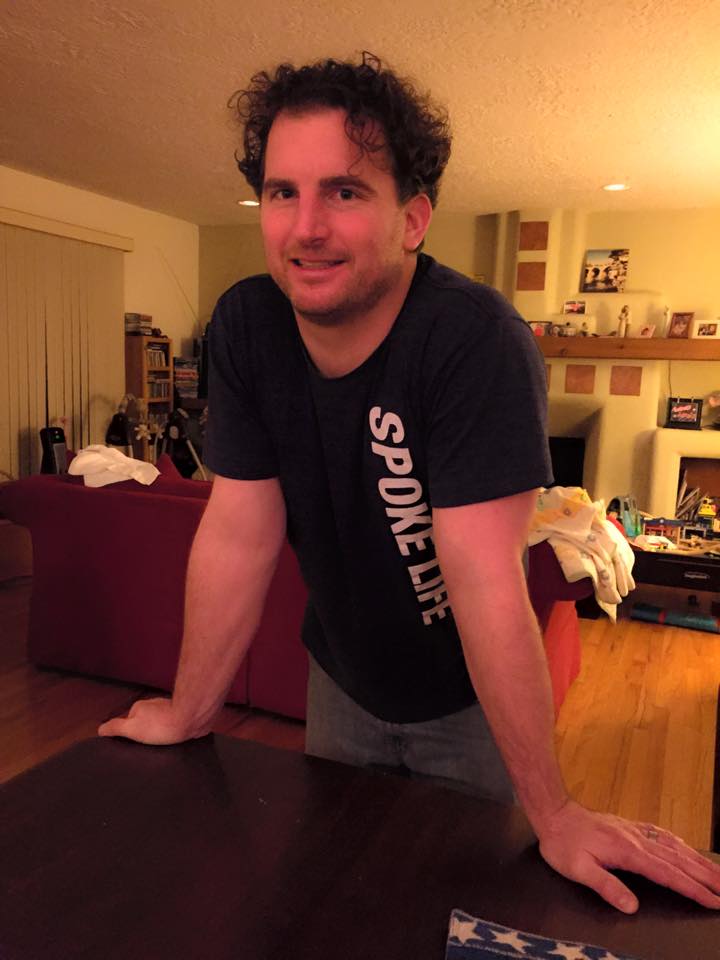
We were sitting at the dinner table when I first noticed the fine lines around his eyes.
I noticed how they splayed from the outer corner, up to his eyebrows and down to the upper-most part of his cheeks.
I felt the tears spring to my own eyes.
I counted them: one, two, three, four, five (like my daughter counting on her fingers)—and I felt lucky to have been a small part of those lines.
I’ve been there through our 14-year-old-concert-in-Detroit days—those moments in our high-school lives when seeing our favorite indie bands was heart-crashingly important and special.
I’d been there through saw-him-move-across-the-country hours—those days that led up to his move to New Mexico for his first Master’s degree, when every day felt soft around the edges and painful-slash-crisply beautiful because he was leaving me for several months until I joined him.
We’ve been together through more life moments than I can count (one, two, three, four, five…) and those lines—in that one perfect instant at the dinner table—those lines said so much.
They said, “I love you,” “I hate you,” “I need you,” “I want you,” “you are me,” and so many others.
And these tiny, little creases in our softest of skin—that we can some how, perversely, see as imperfections—made me smile as the salty tears pricked the backs of my eyes.
I smiled with the knowledge that our current days, of our marriage becoming secondary to our children, and our exercise time never feeling quite like enough, and our lives moving so fast that these lines could be perceived as something to mourn rather than celebrate—I smiled, knowing that all of these life-pieces are temporary, and I teared up because this is both beautiful and devastating.
And I look at the creases of his eyes, as he tilts his head back and roars with laughter at something I’ve said, and I hope in the deepest crook of my heart that there are many more lines to come.
Photos: Author’s own; Flickr/Philip Bitnar.
The post Why I Fell in Love with His Smile Lines. first appeared on Jennifer S. White.
]]>The post The Caged Girls: Saying Good-Bye to Yourself. first appeared on Jennifer S. White.
]]>
Chapter 38.
Her memories come to her in waves and flashes.
Sometimes they startle her in the middle of the night.
She sits up in bed, sweat soaking the back of her t-shirt and lining her neck, underneath her brown hair.
Others, she slowly creeps into a vision, long-held in her muscle fibers without her conscious knowledge. It seeps in and around her and carries her heart to another lifetime and, although hers, it frequently feels otherwise.
The first type of memory—the sudden ones—bring flashes of trauma and grief. The latter, however, bring her pity for a little girl or an old friend and it often takes a moment for her to recognize that her sorrowful empathy is actually—strangely—self-directed.
Yet, memories are like old friends themselves. They greet almost-forgotten spaces of hidden light and joy. They bring snapshots of happiness from a former lover (our own younger selves).
She pulls the blanket tightly around her shivering shoulders; clasping the tattered pink ends together in one hand between her bony clavicles, which are slightly uneven from scoliosis and being broken more than once.
She looks out her window at the smoky, hovering fog and the evenly spaced raindrops; reaching out of her blanketed nest with one chilled hand for her warm coffee mug, the one with the chip out of the corner that says Mommy needs coffee. Give mommy some sugar.
She sips slowly; feeling the velvety, slightly nutty taste roll over her tongue and then smoothly down her throat, but she’s not really there, drinking her coffee.
Instead, she’s sitting on her best friend’s bed after a night out together. They’re talking and telling each other how much it means to have a friend you can share anything with. The best friendships are like this one, too—when you don’t actually need words to round out these self-explaining sentences.
And then she’s in her boyfriend’s arms and he’s telling her how beautiful she is and, remarkably, she believes him.
She’s lying on the couch, fatigued from not eating much of anything that day. And she’s in her boyfriend’s bedroom so skeletal that the flesh hangs off her buttocks—it’s the only time in her always-changing girlhood body that he’s ever found her unattractive.
And then she’s in the birthing room telling her midwife that she can’t do it, although she nearly has.
And she’s standing beside her grandmother’s coffin with her broken teenage heart spilling into the wooden box along with her tears and then she’s mourning another teenager’s death in a high-ceiling church full of natural light and the heaviness of a grief too profound to either purge or bear.
She pulls the tattered pink blanket closer to her neck and takes a drink of coffee. She knows that she needs to be there, in that room, for every swallow.
She needs to feel the nubbly texture of her washed-a-billion-times pink fleece blanket against her skin.
She needs to remember that life is fragile and, alternately, that she’s never as delicate as she fears.
She places the worn, loved mug on the cracked chocolate leather ottoman in front of her.
She feels her arm muscles contract to place her hand back into her lap and she settles into this temporary space of quiet and solitude; of trickling rain and translucent vapor hovering above dewy ground.
She feels the breath flow in and out of her stuffed-up nostrils and she waves good-bye to that wandering girl who stopped by for an early morning visit; to have coffee with her and then to leave her with the inherited insight that life both contorts and transforms into something entirely new so quickly—so quietly and without an advanced warning.
She waves good-bye to her and then she turns, taking one modest step at a time into the lifting fog of her brand new day.
Photo credit: Author’s own.
Visit here for more of The Caged Girls.
The post The Caged Girls: Saying Good-Bye to Yourself. first appeared on Jennifer S. White.
]]>