The post 3 Everyday Ways Anyone Can Choose Happiness. first appeared on Jennifer S. White.
]]>
Today, I feel grateful and ready to enjoy my day, and it’s not a special one.
It’s not an anniversary, or a holiday, or a birthday, or even a day when I’ve had enough sleep or coffee. To be honest, this past week has been emotionally trying, but I’m giving myself permission to choose my positive attitude this morning.
Here are three everyday ways we are in charge of our own happiness:
1. Self-love.
We can choose to look in the mirror, literally and figuratively, and take in what we don’t like—or we can choose to focus on what we do.
While there are tons of things I could want to change about myself, I value the person I’ve worked hard to become, and the person I am innately. I’m not suggesting that we put up blinders to our flaws, or that we can’t work on becoming better people, but there comes a point where if we want to love ourselves, then we need to embrace who we are completely—right here as we stand in this present moment.
2. Perspective.
Nobody escapes this life without challenges or difficulty. However, how we perceive these difficult moments and spaces within our lives is what sets us–and our attitudes and our levels of overall fulfillment—apart.
There will assuredly be periods of heavy sorrow, and grief, and even a little wallowing from time to time—for all of us. Yet choosing to see these people and situations that challenge us as opportunities for growth, as well as temporary setbacks, is paramount for generally enjoying our lives.
3. Imperfection.
Expecting perfection sets us up for not being able to enjoy life.
People will never be perfect, so this means that our marriages won’t look like romance novels, our jobs will always have days when we greatly wish that we were somewhere else, and those we love will have their own needs, challenges and struggles, too.
Expecting bumps in the road, and flaws, helps us to equally choose to witness life’s natural beauty that’s always simultaneously right there along with them.
I’ll give you a nerdy science example from my geologist’s heart:
An emerald, for instance, is a variety of the mineral beryl, and trace amounts of chromium and occasionally vanadium are what give it its rich, green color. Essentially, emeralds are desired because a colorless beryl is “flawed” by the inclusion of these metals, but we don’t look at an emerald as flawed.
A flaw, much like beauty and happiness, lies in how we choose to perceive it.
Our days are like this.
Ultimately, our lives can be seen as a direct result of an accumulation of our chosen attitudes.
The post 3 Everyday Ways Anyone Can Choose Happiness. first appeared on Jennifer S. White.
]]>The post 4 Tiny Habits That Lead to Big Happiness. first appeared on Jennifer S. White.
]]>
My two children getting sick was actually good for me.
I mean, no one wants their kids to not feel well. Still, I had been in a mental and emotional rut in the weeks prior, and it took a week of being stuck at home in a sick house for me to fall back in love with my life.
Sometimes, we need to fall back in love with ourselves, and with our life as it is, right now.
While there is merit to looking ahead, to planning, and to dog-earing goals, hopes and possibilities, it’s equally important to pause and appreciate this ground that we stand on, right here and now.
Life isn’t always wonderful—I had some genuine stressors and reasons that I had been irritable and cranky this previous month. That said, this week was a solid reminder to me that our mood is often a choice—not always, but often. (And honoring unwelcome emotions and thoughts is also honoring being genuine and authentic, but wallowing is rarely positive.)
These following tips might not pay my bills, or babysit my kids for a night out with my husband, or bring world peace, but these habits, put into daily practice, will help me find more joy in today.
1. Stop overthinking.
I overthink a lot. (A lot, a lot.) That said, I believe in doing.
In other words, sometimes we need to stop thinking and take action. Nothing is more of a reminder of this than cleaning up puke or nursing sick children back to health.
So when my sister texted me yesterday that she hadn’t slept well and was also sick and just feeling not so wonderful, I texted back something along the lines of, “Stop overthinking and put on sexy boots. It’s hard to feel like shit in sexy boots.”
Boom. Moving on.
2. Give.
The main reason I finally got my head out of my own rear this past week was because, in giving to my husband and daughters as they didn’t feel their best, I was reminded of how much I, frankly, have to give.
I am a well of love and of capability. I needed to give, and be of service, to my family in order for me to reconnect with my energy that had been lacking and the happiness that is already right here in my living room.
3. Find gratitude.
While cleaning up vomit and worrying about a high fever certainly isn’t fun, cuddling two beautiful girls and watching the just-released Inside Out is pretty spectacular. Additionally, I felt thankful for our general health that makes these types of passing illnesses something kind of awful.
In short, there is nearly always something to be grateful for, and finding it, and giving a brief, silent moment of thanks for it, can be hugely beneficial.
4. Stop giving fucks away.
My two kids getting sick reminded me powerfully of what matters in life. It’s unfortunately easy to forget what matters.
What matters is not social media popularity. It’s not the size we wear. It’s not a new pair of jeans. What matters is, for me, simple: the two tiny bodies I was snuggling on the sofa and the larger one I kissed goodnight.
What matters, too, is my own self-care.
Unplugging almost completely from social media and my phone this week to be with my family made me internally ponder this question more than once: “If Facebook, social media and the internet in general suddenly ceased to exist, how would this impact my life?”
If no one was looking at a picture of the food we ate, or keeping in touch via comments on a picture of my kid, who would I, for example, still talk to, in “real” time?
We spent a lot of the early part of our week outside. The weather was unseasonably beautiful and warm, and I, in general, rarely take my phone with me when I’m playing with my kids, because the sky is always more beautiful when I look at it without a phone in the way. More, when I do stop to take pictures of my girls, the images never capture their beauty or the overall specialness of the moment as it happened. So I stopped trying.
Most of us give away far too many brain cells—and opportunities for happiness—wondering what other people think, or how we can be “better,” or focusing on what we’re lacking rather than what we already have. Checking back in with what—and who—is truly important in my life, I find again and again, makes all the difference in the world; in my world.
So, no, spending a week with sick kids didn’t make money grow on the tree in my backyard. It didn’t babysit my kids so I could write or call my best friend. It didn’t give my husband another day off so he could be home with us. But it did remind me where my life is already wonderful. I hope that next week, when my little world is healthier, that I use these tiny life practices to infuse more joy into my every, ordinary day.
The post 4 Tiny Habits That Lead to Big Happiness. first appeared on Jennifer S. White.
]]>The post How to Know You’ve Had Too Much Facebook & 7 Things to Do Instead. first appeared on Jennifer S. White.
]]>
Facebook and social media can be addicting.
Studies have actually shown a similar activation within the brain as with drugs.
Yet many of us aren’t necessarily addicted to, let’s say Facebook, as we are wasting time.
How do I know I’ve had too much Facebook? By my attitude.
First off, there’s a valid reason for social media, especially with us thirty-somethings, like myself.
My friends and family don’t live near me, and, further, as a mom with two active children, who wants to devote real-life time to them, I don’t want to spend my day texting and sending photos individually—so I turn to things like Instagram and Facebook to connect collectively, to help further relationships I value that might otherwise stall, and, frankly, to save some time.
This said, I know that I’ve been on Facebook too long when I begin to feel catty or mean.
For me—I’ll be honest—this doesn’t take long.
I have a short window of patience in general, and too many cheesy “my family is perfect” moments or “look at how we still get to hang out as a couple despite also having small children” type pictures just get under my skin.
And, yes, I realize this is a reflection of my own wishes for dates with my husband or friends to chill with or for whatever that I think I desire or need—and this is when I know that I need to hop back off-line and back into my actual, living, breathing daily life.
Because happiness is not created through candid photographs or a new, cute top—not that I don’t also love sharing these types of experiences on social media or find them completely invalid in general.
Happiness is breathing into—not through—the life that we currently inhabit and finding joy there; finding a spark of something beautiful, even when feeling depleted, or moving forward, or changing courses, or staying the course.
Happiness is not found on Instagram, or Twitter, or Facebook—and when I begin to question just a hair too much the beauty that resides in my own waking life, that’s when I know that it’s time to do these things instead:
1. Sleep.
I love sleep. Love it.
And now, as a parent who never gets enough, I appreciate good sleep too. So, please, let me share this with you:
Leave your phone outside of the bedroom and, for the love of God, go to sleep rather than peruse Facebook. It will be there tomorrow, trust me.
2. Exercise.
Most of my favorite yoga and Pilates workouts and podcasts are an average of 20 minutes long. The next time you’re on Facebook, notice how it easily eats up at least that much time.
Also, I can bring some free weights upstairs from my basement gym and press out a few strength-building sets within a 20-minutes time frame too.
Point: moving our bodies makes us genuinely feel good—inside and out—and it’s free and device-less and less time consuming than patrolling Facebook.
3. Read.
I hadn’t planned on reading the new Harper Lee novel, but, against previous plans, I decided to.
Yet, last night, when my teething baby wouldn’t fall asleep and after a day of fussiness, I found myself in the rare position of putting my feet up for a few minutes with nothing in particular to do; with no company, since my husband was now roaming the house with our active, mobile child and my oldest daughter was already in bed.
I, likely more by habit than anything else, picked up my iPhone to peruse my social media and read online news—you know, luxurious activities that I took for granted for many years B.C. (before children).
And then I look over and see Go Set a Watchman on the arm of the couch where I had wisely placed it an hour or so beforehand, perhaps anticipating such an evening’s experience.
I’ll admit putting my phone down wasn’t as easy as it should be, and that I still did snap an Instagram picture of the book in my lap before turning it off.
But I did, and I’m so glad—and, let me offer: it was extremely satisfying to carve out a little chunk of this book to have read—much more so than I could have predicted.
4. Another good thing to do: read to our children.
I’ve noticed that since I had my second child, that I can never read to my oldest as much as she voraciously craves it. Even five minutes of reading to our kids instead of being on our phones might make more of a difference than we can imagine.
5. Talk on the phone.
Okay, so I’ll own up to not liking to talk on the phone for the most part, but, more than this, it’s just not something I’m either capable of doing, or willing to take the time to do, as this takes time away from my kids in a life that already seems to be moving too fast.
I’m generally doing other things, like reading…and keeping the busy baby safe—you know things like that.
Still, sometimes I’ll be on Facebook—God, I must sound like a huge dork right now. How many times have I mentioned Facebook?
Here—Facebook, Facebook, Facebook! Let’s throw it in a few more.
Anyways, I’ll see a friend’s name and think how it really has been forever since we’ve actually talked. Or, more often, I’ll think of my parents or a friend who isn’t on social media at all, and, at times like these, I decide to make a phone call.
To a real, live person.
No, not texting—a phone call.
Trust me, this is good for us to do, even if it is quickly becoming outdated.
6. Write something.
Writers and bloggers—this is especially true for you. However, writing in a journal is also something that can be wonderful for all of us.
And it doesn’t have to be a spill-your-guts blank book. It can be simple and refreshing and rejuvenating to jot a few easy thoughts that pop into our heads—with our hands and a pen. (But if you are a writer, prepare for your best work to leak out this way.)
7. Don’t multi-task.
Multi-tasking is a myth. It really is.
No one can multi-task well—we’re actually just doing everything poorly.
Speaking of Facebook (ha!), I know we all have at least one family member who has to share the latest, awful news story featuring things like people being killed…right after posting to Facebook.
Dramatic, sure, but it’s absolutely true that we need to focus on the task at hand, whether it’s concentrating on eating a gooey peanut butter sandwich or driving a car.
I’m not saying that Facebook isn’t worthwhile in its own right.
It’s wonderful, for example, for moms like myself who rarely have actual adult contact during the period of a day and for connecting with long-distance friends and family—but it can also be detrimental to life rather than beneficial.
All I’m suggesting is that we notice when it’s becoming something that doesn’t add to our lives or, equally importantly, to our day.
I didn’t write this post to be condescending or to suggest that these aren’t things we can’t all figure out for ourselves, or that we don’t already know we should be doing.
No, this is intended to be a reminder that it’s these seized and ignored opportunities—like a 20-minute yoga practice or a book read to our child—that end up making up the stories of how our lives go.
Maybe it’s the high volume of times I’ve used the word, but is it ironic that it’s called Facebook?
Because I’m discovering that I would rather turn off my phone, at least from time to time.
I’d rather smile out here in the real world, with the people who matter the most.
I want to make my story go the way that I want it to; to look the way that I want it to, in real time.
I’d rather do this than co-exist within a largely fictitious story of one-dimensional pictures and stream-lined plots.
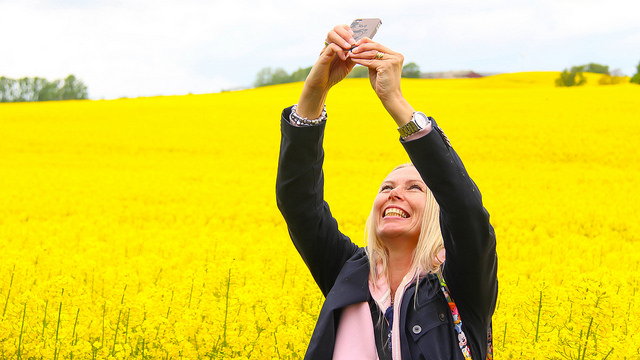
Photo: Flickr/Taking a selfie.
The post How to Know You’ve Had Too Much Facebook & 7 Things to Do Instead. first appeared on Jennifer S. White.
]]>The post Why There Isn’t A “Happiness” Filter. first appeared on Jennifer S. White.
]]>
Have you ever noticed that memories often have hazy, golden fogs around them, and that Instagram’s editing filters are often hazy or blurred?
I’ve noticed lately that we’re all over-using the haze, y’all.
And dreams, for me, are often cloaked in shifty, lazy, idyllic fogs as well.
I once dreamt of a child playing outside, a golden halo of opaque light surrounding her body; making her seem wondrous and perfect in the way that only a dream can.
Why do we remember life as if a dream?
We cling, often, to the best things that someone said, or to a best moment of connection, or to a thought that maybe things could have gone differently in a relationship if we allowed one word to remain unsaid, or said.
And then there are the memories—surrounded by a black haze—that spew the wrong word, or the spitted word, or the relationship’s problem over and over again.
These memories can replay mentally as well, but with nothing to offer the heart—and as little amount of reality infused from within.
Because memories are not real.
They are playthings.
I often dream in black and white—the color that does arise is important.
For instance, that little girl of my dream from several years ago was actually largely a black-and-white dream, and the golden halo surrounding her playing body was in color.
Ironically, memories, unlike dreams, are typically much more black and white—and certainly much more dichotomous than life.
I learned a long time ago that life is shades of grey.
Life isn’t “this is wrong” and “that brings joy,” but, instead, it’s typically an arch of waning and waxing of easy, relatively carefree days and periods of more intensity. Yet it’s these periods of intensity that can breed such an idealistic response.
We become infused with something extremely negative or extremely joyful—like marriage, death, a relationship difficulty, illness, work success—and we think that life is something more than an ebb and flow.
It’s when I remember this ebb and flow that I stay sane in these periods of temporary disarray.
Happiness is disturbing.
Happiness is something chaotic to the stream of what flows naturally through life.
While life should and can be something to behold with relative excitement and adoration, a state of constant happiness would not only mean a flat-line to this feeling in general, but, more, it’s as equally abnormal as a period of constant morbidity.
Because life is not meant to be surrounded by a golden halo.
Recently, I took photographs of my oldest daughter sitting at the hardwood table of her favorite eating spot, a place that offers bowls of real fresh fruit—like slightly smashed raspberries and cut-into-awkward-chunks pineapple—as well as truly homemade hummus and, sometimes, pita chips browned in the oven a touch too long.
Today, my daughter and I went there for the first time since I had her baby sister.
I anticipated a less than simple situation and prepared by telling the waitress we’d be having only the bowl of fruit—along with telling her that we miss our regular visitations and a healthy tip—and by paying the check, and making sure that my daughter—hand filled with crayons and bowed over a printed-but-as-of-yet-colorless place-mat—knew that this would be a short stay.
It went well.
Granted, we were there for 15 minutes.
But it went well.
She was, of course, ecstatic to be at her old stomping grounds, to have eaten a portion of a bowl of delicious fresh fruit and to know that life isn’t the same with a baby sister as it was before—but that we can still do beloved adventures.
That said, the picture that I chose to take and then post later on my Instagram account was much sweeter than the actual visit.
The actual visit involved wondering if my dress would be tattered and needing changed from the baby parading all over it, while I tried to hold her wriggly body in my lap.
The actual visit involved my daughter wanting to color for longer, and for me to color with her—like we used to—only it was made impossible by this sweetly squirming little sister.
The actual visit involved me looking gratefully at this baby as she took in scenery, while wishing I could even just pretend to spend as much attention on her “firsts;” on her newness.
This photograph did not look like our real encounter—much like life is not, thankfully, surrounded by a golden, hazy Instagram filter.
No, life is wondrous, and chaotic and awful and easy and plain.
Lately, I feel like the Tasmanian devil.
I feel like my kids and I pop into places and are a swirling ball of activity and then—just like that!—we’re gone.
We are energy and too little sleep and too much coffee—or not enough.
We are everything but an Instagram filter.
We are real life.
I inhale deeply through my nose, pause, and exhale out my mouth—I take a moment to hold, deeply within my tissues, my day.
My day was not preceded by enough sleep.
My day was a beautiful child looking at me—directly in the eyes—and smiling. My day was a baby’s proud face as she held herself steady on her own two feet, all by herself.
My day was, at times, surrounded by this perfectly coveted, glimmering mirage—mostly because I chose to see it that way, despite my lack of sleep.
My oldest daughter sits in front of the large picture window overlooking our side-yard as I hover over my keyboard writing this. She plays with my shoes, still in boxes from our move—we haven’t moved recently enough to excuse these boxes of shoes.
She looks beautiful. My mind will remember her this way and not the stress that I feel from needing to put away the rest of my shoes and clothes.
Because it’s important to remember that we are not paintings or pictures of perfection.
We are not brushstrokes or filters, or even the false remembrances of our own imaginations—we are more.
Our memories have golden, hazy smokescreens, not to disappoint reality or to trick us, but because it’s healthy and right to find the best out of life.
The problem arises when we compare real life to something synthetic; something grainy and outright dishonest instead of the crystalline focus that we actually live through, as we go through it.
It’s important to understand completely that real life was never perfect—that a picture on Instagram might be changed. More, it’s critical to understand that nothing is Photoshop-picturesque if we want to truly live a happy life, in real time.
We can do better than showing the world—and ourselves—only tiny snippets of something false; something we wrongly imagine to be the only aspect of ourselves worth sharing.
Photo: Anna/Flickr.
The post Why There Isn’t A “Happiness” Filter. first appeared on Jennifer S. White.
]]>The post 7 Things I Repeatedly Do to Stay Sane & Happy When Life Sucks. first appeared on Jennifer S. White.
]]>
Every now and then there are spaces in life that feel like they exist purely as tests of will and mental endurance.
For me, these last several months have been one of those times.
Simultaneously, though, as life often happens, wonderful things have co-existed in this same tender, frustrating space.
Just today—when I find myself internally cheerleading that we’re nearly through it! and go, team, go!—I’m driving down a windy country road with unexpected construction, behind a truck depositing gravel, when a piece of loose stone flies up and nicks my windshield. Then I momentarily find myself stopped and waiting to be able to pass through this now one-lane road, talking to one of the workers. At one point, I get out of my car and show him the nick as he’s giving me a phone number to call.
Later, when I’m driving home, I feel the stick, stick, stickiness of my feet as I alternately press the clutch and gas pedals. I mentally slap my forehead with my hand and think, “Doh! Tar on my most expensive and newest shoes.”
I spend the next hour with a toothbrush and various soapy concoctions scrubbing at them in my kitchen sink.
My mental cheerleader vanished and turned into a not-so-cute devil perched upon my weary shoulder.
I’m back to feeling easily agitated and to taking in deep breaths before responding to something challenging that my small daughter does. More and more, I find myself wondering why my life has been such a string of bad-luck-type events when, for one, I don’t believe in bad luck and, for another, I genuinely seek a life of no drama; one of joy.
Yet, sometimes, regardless of our intentions or luck status, we find every wonderful, glorious life occurrence colored—or dimmed—by the shadow of something difficult. While I certainly haven’t come up with the perfect answer to why this is, I have come up with something that helps me work through my life and, better still, to enjoy it.
I do this:
1. I breathe into my heart space.
I intentionally slide my shoulderblades down and lift my heart skyward.
I inhale into my expanding chest, feeling the power and healing of breath, and I exhale the tensions out of my neck and jaw. And when I forget that life is something to be taken in stages, one step at a time rather than in dismissive chunks and fundamentally unobservant journeys, I remind myself to inhale, exhale and repeat.
2. I sing.
At the top of my lungs.
In the car with windows rolled down.
In the kitchen with sauces simmering on the stovetop.
I sing softly to my tiny daughter and I sing spontaneously as the water runs down my body in warm showers.
I sing.
3. I laugh.
When I want to cry. Well, okay, sometimes I cry. However, generally all we need to do is look at life differently.
That tar on my shoes? Really. Something like that could easily have ended up in a bad story.
Um, moving on.
4. I pray.
Last night I found myself praying and then feeling silly because I really didn’t know who the hell I was praying to. Regardless, I did. And I felt better.
5. I eat.
I don’t eat to soothe myself and I don’t cook to pacify the people I love. Instead, I eat as a normal, healthy human animal does, but I pay attention to the crispy crunch of tortilla chips or the chocolate-y, velvety texture of my first cup of morning coffee—and it reminds me that every moment of my ordinary life is something to be taken in, appreciated and felt (even when that coffee burnt my mouth this morning and I was suddenly spitting my first sip back into the cup).
6. I love.
I love fiercely.
I love completely.
I love easily.
I love openly.
I love jealously.
I love compassionately.
I love with my whole being and, likewise, I love myself this way too.
7. I dance.
I dance on my rubber yoga mat.
I dance as I flow from Warrior I to Warrior II. I dance to the steady thumping of my heart and the slow drops of sweat as they roll down my body and onto my purple mat.
And then I dance as I write.
My fingers move and flow across the black-and-white lettered keys.
I let my heart ooze out of my hands and onto white-and-black screen, and I feel this dance leave my body and a new shape forming within my awakened soul; a new song to move to on another day.
And then my daughter and my husband are nearly done preparing dinner.
I breathe in the aromas as I let my fingers glide across my laptop keyboard; as I sit writing at my worn antique dining table.
My fingers slow and slow and slow like a winding down ballerina nestled inside a music box.
I inhale, I exhale, and I realize that the tar was just on shoes and the nick was just on a car, and that my bare feet alone can handle my earthy, strong steps and that I don’t need a vehicle other than my own body to carry me through life.
Repeat.
Photo: Flickr/Dani_vr.
This article was first published by elephant journal.
The post 7 Things I Repeatedly Do to Stay Sane & Happy When Life Sucks. first appeared on Jennifer S. White.
]]>The post UPDATE: Book Release! The Best Day of Your Life is Available for Purchase! first appeared on Jennifer S. White.
]]>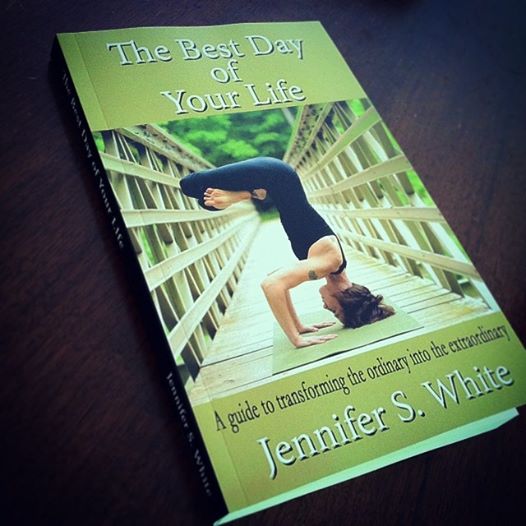
My labor of love is finally out in the world!
The Best Day of Your Life: A guide to transforming the ordinary into the extraordinary, is now available for purchase in paperback on Amazon and in Kindle form as well!
And here’s an exciting update: it’s now out at Barnes & Noble!
A brief description:
“Every day that we inhale a new breath and then let it back out is an opportunity to have the best day of our lives. That said, it’s not always this easy.
Life is challenging and complicated, yet we seek out positive expressions of ourselves and the world, like joy and serenity. We’re essentially healthy people trying to get through life with as much pleasure as possible. We seek to better ourselves and the world around us because, at our core, we want to live our best lives as our best selves.
But how do we do this? How do we have our best day when we’re feeling frustrated, heartbroken or a plethora of other emotions that swirl around a human experience?
This book offers a daily practice guide that doesn’t attempt to give you the answers to these questions, but, rather, the tools necessary to engage them on your own journey.
And some of these practices might surprise you. If you’ve picked up this book expecting a typical put-on-a-smiley-face-and-shove-down-uncomfortable-feelings manual, you won’t find that.
What will you find within these pages? Open it up and let’s begin…”
I’ll also be updating this post as new links go up. (So keep checking back.)
After you’ve given your copy a read, please review it on Amazon! Also, any inquiries about professional reviews can be sent directly via message on my Facebook page.
I want to send a sincere thank you out to every one of you who have encouraged and supported me.
Thank you, thank you, thank you, from the bottom of my happy, happy heart.
The post UPDATE: Book Release! The Best Day of Your Life is Available for Purchase! first appeared on Jennifer S. White.
]]>The post 10 Things Your Happiest Self Wants You to Do Every Day first appeared on Jennifer S. White.
]]>
Your happy to-do list.
Yesterday I was such a grump. I told my husband that my body felt like dog poo.
All week long my yoga practice had been ho-hum, my runs were inconsistent, and I was feeling just plain yucky.
This morning, however, I decided that it was high time to turn my mood around—so I took my tiny lady and her jogging stroller out for a run on my favorite trail.
The sunshine peeked through the trees, not quite sure if it was ready to be awake yet. (I can relate.)
The grass and foliage were lush and green thanks to all the rain we’ve had here in Ohio.
My body moved, and as it did the tightness drained, not only from my muscles, but from my mind and heart as well.
Aaaah, this is life.
Way too often I get caught up in the cerebral part of being human and forget to just move and breathe and be an animal—which led me to ponder those days that start out great (like today) and are wonderfully serene and happy throughout, right up until my head hits my pillow.
What is it about these days that make them so fantastic and joyful?
So I came up with this list of things to do if you want to enjoy simply being alive.
1. Move your body. Do something that gives your body a little bit of exercise every single day. You don’t have to hit the gym or go to the yoga studio or even dedicate a full hour—just do something, anything really.
A few of my preferred mood-boosting body moves are: dancing in the kitchen with my daughter while making dinner, taking a short walk in nature and breaking out five minutes worth of yoga core moves in the middle of the day (talk about quick energy).
2. Drink water. I love water—obsessively and adoringly. I know that some people find water to be a boring drink, but your body needs it, so drink up anyway. (After all, dehydration can lead to a serious case of the crankies, you know.)
3. Laugh. Find small ways to add laughter into your day.
Whether you call a friend who always cracks you up or you watch a stupid SNL skit you love on youtube, it doesn’t matter.
Better still, lighten up in general, and notice the humor that exists in your every, ordinary day that you often completely ignore. (If you’re really at a loss then watch a child—they find delight in those little, tiny moments that we adults sadly stopped noticing years ago.)
4. Be authentic. There’s nothing more unhappy than being phony. Try as hard as you can to let down your guard and just be the real you regardless of your setting. Easier said than done, I know, but it’s well worth the effort because putting on different masks for different people is exhausting.
Consider being open to the possibility that you are wonderful exactly as you are.
5. Eat healthy food. Ugh, eating crappy, processed food is sure to make your entire system feel lousy.
Fill up everyday on fresh fruits and vegetables—and pay attention to how good it makes you feel.
6. Yet still allow treats. I absolutely believe in eating dark chocolate and drinking wine and hoppy beer—in moderation.
One of my favorite ways to complete a good day is to break out one of my teensy, pretty chocolate plates along with a couple squares of the good stuff.
7. Do your chores. I sincerely do not like housework. I don’t like doing the dishes. I have a severe disdain for laundry. And you know what? Too bad. I have to do it anyway—and I always feel better after I do.
8. Reach out and touch someone. People are made to be social creatures. We need affection and good ol’ fashioned touching. Spend time cuddling with someone special and I promise you’ll feel amazing afterwards.
9. Remember tomorrow. When I felt horrible yesterday, I knew that I would feel better today. Sometimes the best thing you can do for yourself when you’re feeling down or things aren’t going exactly as you’d like is to remember that, thankfully, life is an ever moving ocean filled with changing tides.
10. Practice kindness. I’m telling you this from personal experience—being a jerk will not make you feel good. Rather, smile and extend your kindest you out into the world—because it’s entirely true that the love you take is equal to the love you make.
I think I’ll stop here for now—because the thing about happiness is that it’s not complex.
Happiness is noticing and then hanging onto those little things in life—hugs, sunshine on your skin, the after-effects of a great workout—that we too easily let slip past us.
“Happiness is not something ready made. It comes from your own actions.” ~Dalai Lama.
Photo credit: ClickFlashPhotos /Nicki Varkevisser/Flickr.
This article was first published by elephant journal.
The post 10 Things Your Happiest Self Wants You to Do Every Day first appeared on Jennifer S. White.
]]>The post The Caged Girls: How to Grow Wings. first appeared on Jennifer S. White.
]]>Part Seven of The Caged Girls: How to Grow Wings (Chapters 20 through 24).
Chapter 20
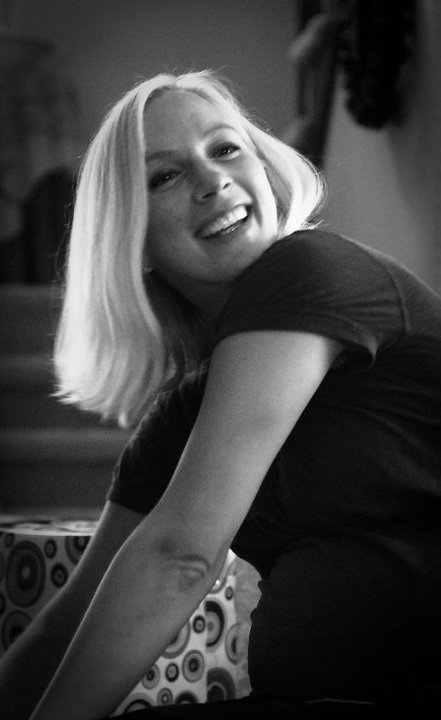
I’ve never been happier in my life, than when I was pregnant with you.
This doesn’t mean that my life was perfect.
I had difficult people running in and out, under the guise of challenging me to grow. I struggled to earn a reputation as not just a good yoga teacher, but a great one. I wasn’t rolling in money and our bathroom toilet frequently backed up—the only one in the house, mind you.
Yes, I had morning sickness—or, more accurately, all-day sickness—making the frequent joke that this term must have been made up by a man.
I taught classes at six in the morning, went back to teach at noon, sometimes subbed in between and then regularly subbed in the evenings. In short, I worked a lot and life wasn’t faultless—but, still, I know without a shadow of shaky idealistic doubt that I was positively the happiest I’ve ever been, when I was pregnant with you.
But then life doesn’t always happen according to plan.
Struggles that seem like they’ll break you rise and shine and start each new day and you watch the man you love more than anyone in this world—besides you, my dear child—dissolve into fits of anguish.
I had forgotten entirely what it felt like to be a shell of a woman.
I’d let go of that eating disordered girl years before—just turned my back on her and walked away. However, it wasn’t until I’d hit the largest obstacle of my life to date—without resorting to anorexia—that I knew I was truly healed, and I learned another lesson, too: that turning your back on something and letting it go are two entirely different things.
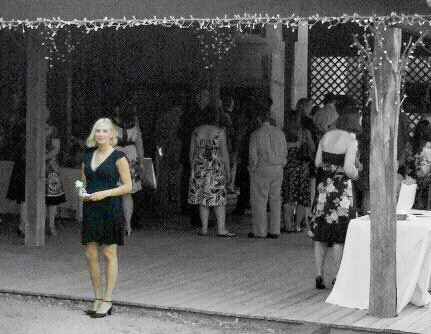
(P.S. That’s me at five months pregnant with you.)
Chapter 21
Hot tears stream down your temples.
They run in a quiet yet small stream that remind you of riverbeds made of black Egyptian kohl eyeliner.
Your hot tears trickle onto your bed where you lie on your right side in the shape of an L, bent at your hip creases.
You tell people that you are not a crier. You know that this only partially true and that we all cry, some of us just more—or less—willingly than others.
Ironically, you also consider yourself a fragile human being, but this fragility has encouraged you to move through your life with a nicely-built, thick shell—a shell that you falsely think is impenetrable to outside attack.
And you know that you are quite vulnerable in reality. Over time, you’ve encouraged yourself to drop your mask—watching it shatter and crack into fragments—only occasionally gluing it haplessly back together to don it once more.
You wear a mask of ego, of confidence and of an easy social butterfly—and sometimes you are these things—it’s not a mask, it’s the real you.
Your eyes are clamped shut and you hear a rustling at the edge of your bed where you still lie sideways in an L.
The soft whisper, whisper of movement is your tiny daughter as she comes in gracefully—delicately—to wave bye-bye to you before Daddy takes her to pre-school. The tears fall harder—now less of a quiet stream and more of a gathering storm.
You hear your husband in the kitchen, moving quickly and capably, to fill your last-minute request of child prep and school drop-off because your headache makes you feel that you cannot face the muted light of the cloudy day, much less the bright faces of other children and their bustling parents.
You’re thankful; thankful for a man who so lovingly steps in and for a daughter who, with your eyes re-closed, you feel gingerly brushing your hair for you—it’s a loving gesture from one female to another, even though one is only a girl of barely three.
You’re grateful for—no, mesmerized by—the old soul that inhabits a body of such miniature proportions.
She hugs you gently, and looks deeply into your wet eyes as she pulls away. She smiles and runs after her Daddy as he opens the front door.
The door shuts and you let your tears fall heavily onto your turquoise quilt.
This is the anatomy of letting go.
You saw your massage therapist yesterday and she released a spot underneath your shoulder-blade that you’re not sure has ever known relaxation—it’s uncomfortably close to your heart.
You drift into such a state of peacefulness that your skilled therapist notes your tranquility out loud. She tells you tostay there, so you do.
You observe later that the release has moved up from your shoulders—from the back of your heart—and into your throat.
Your throat becomes irritated and you lose your voice, much to the disappointment of your duet-loving daughter.
Still, you recognize that release—that letting go—isn’t meant to be comfortable.
You’ve held onto these emotions so forcefully that your muscles have knotted in places and your jaw can’t help but clench in your sleep. You dream of crumbling teeth.
And you slept well last night—much better than usual despite your aggravated throat—and you woke with a headache so fierce that you thought you might throw up.
Your head pounds while the space behind the back of your heart is strangely calm and still relaxed.
Your voice is still gone and there’s an enormous pressure between your ears, but you know that this is simply your clung-too past leaving your aching body.
You clumsily find your phone and call your doctor, making an appointment that gives you just enough time for a hot shower.
You know that she’ll most likely tell you that you have another sinus infection—you’re almost positive—and, yet, it doesn’t matter because you know that this is simply how it feels to let go.
This is the anatomy of liberation.
You pat your dripping hair with a warm blue towel after turning off the shower. You throw on yoga clothes, not because you think you’ll practice in them today as normal, but because they—in their own funny way—are an armor of a different kind—one of health and wellness, of happiness and ease.
You know that your pounding headache won’t last forever, although it worsens when you bend over to tie your jogging shoes. You know that it won’t last forever because you’ve become both too tired and too strong to hold onto your suitcase of burdens anymore.
It’s now your turn to open the front door, and, looking over your shoulder at your daughter’s pint-sized pink and white table and matching chairs, you visualize her waving bye-bye and do the same, and though your hand doesn’t move, you are saying good-bye—and you know that you’ve just made space to carry what lies ahead.
Chapter 22
I sit stiffly at my old dining table.
I feel rigid.
My fingers are pale from the lack of winter sun kissing it and my nails are painted a rich, dark blue. My ruby ring—shaped like a slice of the moon—is large and heavy and it doesn’t turn while my fingers race across my laptop keyboard.
My skin is not only pale, but it’s dry from the lack of humidity in the air. Strangely, however, I’m not ready for the end of winter to come.
Others are counting down days, while we sit patiently or irritably within this Midwestern season of arctic cold and snow accumulation. Yet I feel as if this parched season of chilliness settles perfectly into the stillness—the tiredness—of my bones.
My fingers move more cautiously than normal. The words don’t want to come, because I don’t want to anchor into my beating, churning heart.
This morning my tiny lady and I drove to her music class and I purposefully—and unusually—left my sunglasses off. And it wasn’t just the several inches of white that had fallen and then stuck the night before, but the ironically dry road that reflected the sun so brightly that it reminded me of an ocean—a sea of blinding yellow-peach light that felt like I was driving my little silver Volkswagen into a strange morning dream and not towards a shore of store fronts and rush hour traffic.
What hit me most about that gorgeous wash of early sunlight on the street was that I felt like it was washing me.
A euphoric calm penetrated my depths, as I sat on my heated car seat with my hands at ten and two o’clock. My daughter was quiet in the backseat, looking out the window.
And as I’m driving and this sensation is beginning to approach me on a conscious level, I recognize that the song playing through my car stereo has the refrain “big hard sun.”
I listen, I drive and I feel like everything will be okay, even though mentally and externally it seems that life is not coming together the way I have falsely—rigidly—designed.
We pulled into our destination—a muck and slush-covered parking lot next to the music building—and the tranquility dropped away, but I held onto that indescribable internal stabilizing and settling as the day wore on; as I eventually put on my sunglasses; as I drove home with a different song playing in the background—and as my emotions became more and more turbulent.
Chapter 23.
The family heirloom ring that I wear most days on my right fourth finger twists and turns as I type. The words do not want to come out.
Normally they burst forth with such a wave of passionate explosion that I can’t contain them, even when I sincerely give effort to doing so.
My right hand hovers above the laptop keyboard, moving quite a lot even though I’m willing it to hold it still.
Nerves are a funny thing.
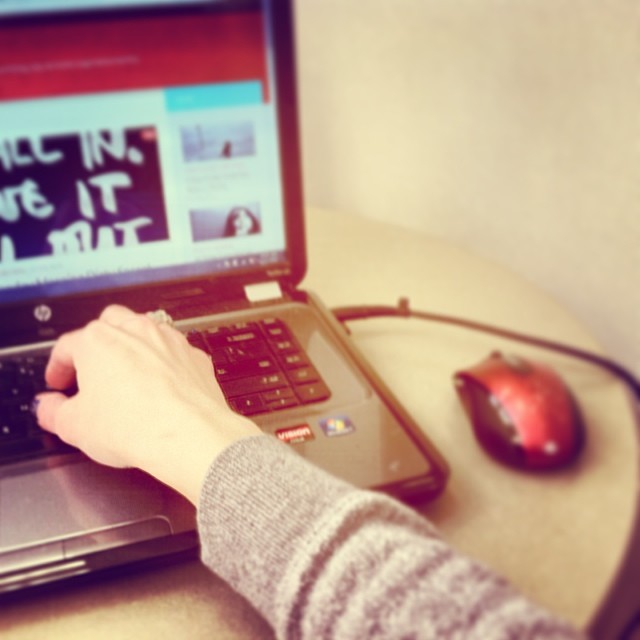
I’ve been up since three a.m.
I awoke next to my daughter in pink princess sheets—her breath softly filling up my inhales; her delicate sleep sighs making me quake with love. I tip toe out of her room; shutting the door quietly but it still creaks into place anyway. I move methodically through making myself coffee; opening up the laptop.
I realize fairly early on that I don’t want to write about feeling this way because how do you describe anxiety as anything besides its unpleasant play of tangled emotions, sitting in the base of your stomach, making you want to vomit before you’ve had anything to eat or drink.
It hits me suddenly that this one person is my home; that this one, fragile human life has been my home base.
And how do you tell someone, in their tender earthbound skin, that they are your gravity; your weight; your lifeblood? How do you make enough homemade chicken soup to soothe an always breaking and repairing human soul? How can words not fail—despite all of their glory and aspiration—to convey something as unlimited, as unquenchable and as indefinable as love when their own shapes have beginning strokes and ends?

We tell people that it will be okay and that all things work out for a reason, but is this really true? Or are we just filling the uncomfortable space of the uncertainty of life with our flat and hollow mortal words?
I will not pour emptiness into the space just to watch it fill up.
But then I find myself shyly whispering it’s going to be okay.
Because, as it turns out, I’m not filling space with shallow words—I’m filling up another’s heart with love from my own.
Chapter 24.
We hold feelings and experiences in the tissues of our bodies—this is another belief and reality of a yoga practitioner.
I don’t doubt this because I observe the way I clench my jaw, my abdomen, and how I grip throughout my hips when I’m stressed or anxious.
Our hearts and our emotional beings are intrinsically connected with our physical selves.
I notice that I can work so hard to mentally get myself out of a bad mood or an intellectual funk and then I get onto my mat and flow and breathe and be and it just disappears all by itself, by working my muscles in and out of yoga poses.
And as an extremely sensitive, empathetic person, my yoga practice has played a crucial role in my self-love and my willingness to want to get out of my cage—to want to grow up into a strong, whole woman instead of living as a broken little girl.
But that’s the strange thing about healing and about love—we don’t always want to get well.
We don’t always want to be whole. It can be much easier living as a hollow, breakable individual because we’re not filled up with the gooey, mushy, penetrable parts of us that are never immune from pain; from hurt.
And the anorexic attempts to break herself first—a preemptive strike; a self-defense.
It doesn’t work.
Instead, she lives in a constantly broken state of pain and every small, inevitable blow of life comes crashing down with full-force blunt trauma that has the speed and power to cripplingly wound rather than temporarily disable.
What begins as self-salvation from a terror too large for her to handle turns into her Achilles’ heel; making everything that comes her way nearly impossible to manage.
She digs herself into her own grave, even though that was never her intention. Rather, her aim was to set herself free—to fly high above her worries and her sorrows—but now she has nowhere to go but down, down, down or up at a nearly vertical angle.
So what does she do?
Does she keep burying herself?
Or does she grow wings, so that she can finally fly, as she’d originally tried to do, but in vain.
Photo credits: Author’s own; Arwen Abenstern – KWP/Flickr.
The post The Caged Girls: How to Grow Wings. first appeared on Jennifer S. White.
]]>The post The Caged Girls: I Heard a Caged Girl Sing (Chapters 11 & 12). first appeared on Jennifer S. White.
]]>
Part Four: I Heard a Caged Girl Sing
Chapter Eleven.
I gingerly placed her sleeping body on the red microfiber sofa.
She twitched slightly, but continued to sleep heavily as long as her beating chest was touching mine. Whether through imagination or actuality, I’m still not sure, but I swear to this hour that I could feel her tiny heart pumping her mighty blood when my breast was pressed to hers.
She never naps and, while I don’t believe in saying never, I will faithfully say that she never naps.
Regardless, I’d transferred her skillfully—after much I-can’t-believe-she-fell-asleep-here practice—from my loving-mother arms within the cocoon of my rickety childhood rocker—the one with the skateboard ball bearings in it, thanks to my inventive husband—and onto the red couch. But then I couldn’t move.
Rather, I didn’t want to.
In that space of my life, I wanted to stay, right there, forever.
Rarely does that happen—I’ll admit I’m rather fidgety. I can’t even handle having both of my hands occupied, because it’s too confining and claustrophobic. I am not claustrophobic. (After all, I’ve spent nearly my entire life inside of a beautifully decorated, exquisitely hand-crafted cage.)
Yet, in that instance, so forbidden from deep breath and any movement at all—for fear of waking my slumbering child—I could not have been overly contained.
I feel vividly my difficult decision to let her rest, alone. I remember, next, walking away and unrolling my mat.

And although all I truly wanted to do was watch her sleep, I knew that I needed to practice.
My yoga practice centers and grounds me—it brings me back out of the life that I perpetually inhabit, inside of the imaginary but imprisoning six walls of my mind.

With my heater pumping—white noise for her and heat right by my chilly purple mat for me—I flowed.
Inhale, arms reach up.
Exhale, arms sweep down and around into prayer position in front of my chest—where I just held her.
Inhale, close my eyes and forget about my breath; set an intention for what lies ahead on my sticky mat—of course, I set an intention of love towards her.
And as I needfully moved my body in and back out of poses, I realized that I had more energy than I thought—and that I had more stamina in my beating (but tired) bosom than I recalled.
Sometimes I feel the weight of life with so much forceful pressure on my fragile bones, that it’s as if someone is trying to keep me from standing back up—and my yoga practice returns me to that place inside that doesn’t fluctuate with moodiness or feel life’s difficulty or even the bliss; that place within that some people might call a soul, and that I know is the only real thing about me, even if it’s the one piece that I can’t see or taste or touch.
Moreover, my practice reconnects me with those daily, tiny amusements that are too often skipped past—correlated incorrectly with a lack of importance instead of being taken in for what they really are: life.
The way that my feet stick and un-stick on my mat when I move.
The sensation of my heart reaching towards the sky when I shine my fingers there and then look up at them.
The miraculous awareness that my body is my home, as much as and as little as a sea-born animal inside of its temporary—but beautiful—shell.
I check on my daughter, still sound asleep on the red microfiber couch. She coughs and moves a little before falling back into dreams. The sun is setting, and her dad will be home from work soon. Quietly I open up the two hard pieces of plastic that make up my laptop and I sit down to write.
She’s immune to my clickity-clack, clickity-clack.
Situated near her, on the other side of the red sofa at our scratched, antique dining table, I let myself be washed over by a deep sense of tranquility—I give myself permission to feel joyful without needing a cause to justify it.
Because while life is undeniably difficult, it’s also an immeasurable well of wonder—and of love.
Chapter Twelve.
Obviously, I can be a serious sort of woman—don’t let this fool you.
I wanted to label the previous chapter “This One Goes to Eleven.” (If you don’t get that, please Google Spinal Tap.)
Also, don’t let my statements of rarely crying misguide either—because I’m starting to think that this might not be the case.
I’ve always said that if we are something, we don’t have the same need to shout it from the rooftops. Announcing ourselves with labels on a regular—and loud—basis primarily serves to prove that we wish we had this particular quality, but since, alas we don’t, we’ll declare it boldly for ourselves instead.
And the truth is that I’ve become significantly mistier in my advanced age. (I believe I’ve told you I’m in my thirties, and, while not an advanced age—that’s a joke—it’s definitely a pivotal place where it becomes wholly too much work to maintain something that we are not—even if this deceit has been hidden from us consciously.)
I’m absolutely determined not to be a water-works factory in front of my child—for many reasons I’ll get into later and a few I’ve already shared—but, simultaneously, I can’t encourage her to roam freely while I stay hidden inside of my own caged heart.
I can’t tell her that grown-ups are wrong when they tell us not to cry or that life isn’t sometimes so breezy that we get swept completely off our feet, when she’s fifteen and had her heart broken for the first time.
I can’t help her live from the depths of her authentic soul if I don’t, correspondingly, live from my own. (Well I can, but she’ll likely see through that before she’s even gotten to middle school.)
So here I am, screaming from the rooftops—or from the front of a purple rubber yoga mat situated near a red couch—that I’m a woman who loves—who needs—to laugh and joke and play and smile and cry and weep and feel.
And sometimes she’ll find her mommy howling at a bright, circular moon or hidden underneath soft blankets on a red sofa—and I’m sharing this sensitive, inquisitive, intense true self with the world because I want her to do the same.
Because I don’t want to someday find her—singing herself to sleep—inside of a dark and lonely cage.
Photo credits: ajari/Flickr; Author’s own.
The post The Caged Girls: I Heard a Caged Girl Sing (Chapters 11 & 12). first appeared on Jennifer S. White.
]]>The post The Caged Girls: Yoga Pants, Sticky Mats & Freedom (Chapters Six Through Ten). first appeared on Jennifer S. White.
]]>Read Part Two of The Caged Girls: A Life in the Mind (Chapters Four & Five).
Part Three: Yoga Pants, Sticky Mats & Freedom.
Chapter Six.
I look down the length of my slim legs, covered in orange and purple, sunset-patterned yoga pants.
I plant my hands shoulder-distance apart and reach my right leg long behind me, hugging my left thigh in tightly. I press up into this hugged-leg variation of handstand and hold it for almost three breaths before coming back down.
My daughter catches me watching her as she prepares to practice her own three-legged downward dog on her scaled-down, matching mat next to mine.
I’m overjoyed in a way that I’ve never felt before—I can’t believe this tiny lady actually wants to practice yoga with Mommy—she asked me—and I’m frequently in awe of the fact that I love this practice, in general, so much.
I was never an athletic kid, like my little girl. I was not a person who relished sweating and panting and team-played sports—I was not this person until I found yoga.
Sure, I swam and I ran and I hiked and I exercised, but I never authentically enjoyed the sensations of physically moving within the structure of my body, the way that I do when I’m in clingy leggings on a sticky mat.
Returning to my practice, I move and breathe and flow and, alternately, observe my mini yogini out of the corner of my eye.
Inhale, arms sweep up—she, too, reaches arms high, only their relative shortness to her head makes her wonder if she’s doing the pose incorrectly, so different is hers from mine.
Exhale, forward fold—she comes down to her knees and looks up at the television screen, where another seasoned yogi is giving us our cues.
Inhale, halfway lift—she takes a break and plops down in front of her primary-colored piano.
Exhale, step back to downward-facing dog—she returns my gaze and hops onto her tiny mat to rejoin me.
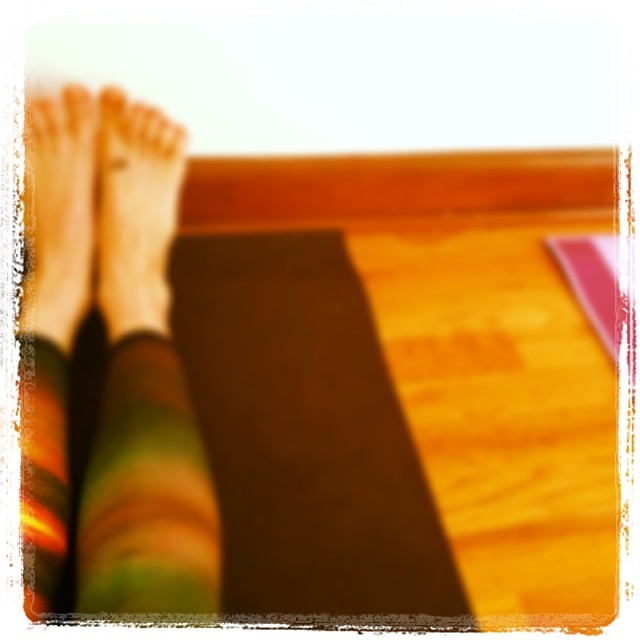
After our physical practice is over, I make us three slices of peanut butter-honey toast, cutting gooey bite-sized pieces up for her. I have a coffee in my green ceramic, handle-free mug and she drinks mango juice out of her sippy cup—the one with her name in bubble letters on the side for when she takes it to preschool.
She wanders over to the blinds and shifts the curtains just enough to open and close her small fist—waving and saying hi to her daddy shoveling snow.
The ease with which these two exchange their love leaves me feeling like an outsider.
I move intentionally from my own finished-practice kneeling position to child’s pose; my forehead resting on the firm, waffle-textured rubber mat.
I’ve shifted here because I feel tears welling up from behind my eyes and I don’t want her to see them spill over.
I don’t cry easily—I have luculent day dreams of violent wailing because I know how good it feels to cry. Instead, I’m the woman with red, puffy eyes looking away from the grocery store clerk ringing up my kefir and beer because my body chose to let go in the middle of a day full of errands.
My breath hitches—no longer the smooth, skillful yogi—and she moves swiftly from behind the parted curtains to standing in front of me on my purple mat—our purple mat. She takes my hair in her left fist and tugs. I resist—she’s trying to make me look to her, to see if I’m okay.
Although a toddler, she’s authoritative—I think I’ve mentioned this—and, before I can help it, my wet eyes have met her confident ones.
My breath slows.
Inhale.
Exhale.
Inhale.
Sigh.
I hear clomping foot stomps on the wooden porch on the other side of the large front picture window—those panes of glass the only things separating our purple sticky mat and him.
I inexplicably recall something that he said to me after I’d finished writing my first book.
He’d loved it—truly—but he said that he was disappointed I hadn’t written more about my yoga practice—he thinks it’s a major part of my life, of who I am—and of who I’ve allowed myself to become.
He opens the front door and embraces our just-above-the-knee person, clinging to his snow-covered pant leg.
We talk for a minute, and then I take my green ceramic mug into our bedroom. I close the thin door and open my laptop’s two hard pieces of plastic, resting on our bed’s turquoise quilt.
I look down the length of my slim legs, covered in orange and purple, sunset-patterned yoga pants…
Chapter Seven.
So the reason for my child’s pose, purple mat tears yesterday was that he and I had a fight.
But not just any fight—one that I started.
While I don’t get off on fighting, I also won’t avoid it—it’s a necessary evil of both a strong relationship and one composed of two strong people—which is why we work so well and have for nearly 20 years—because we won’t let ourselves be bulldozed by the other partner, but we’re in love and compassionate and compromising.
Sometimes, though, I feel like I’m not meant to be around others.
I see myself curtained—cocooned—in sheer, white tulle that canopies my beckoning mattress—my siren—in the middle of the forest. My familiar turquoise and brown-textured notebook is there, along with my preferred ballpoint pen. I’m not wearing phony fairy wings, but I’m equally not my same, assumed human form.
It’s quiet here—completely still—except for a light wind ruffling the tree branches high overhead, but not my loose brown hair (because of the translucent curtains). It’s soundless, too, except for a swaying breeze, coupled with a hidden source of falling water (so soft that it’s almost inaudible, but it’s loud because of this relative silence).
And I’m alone—but nestled deeply within my breast is the critical knowledge that I’m loved—and that’s when my sheer, white, gauzy curtains part and I peek out from my self-imposed wilderness to see, on the other side, my light-colored wood floor waiting patiently—and my red microfiber sofa waits too, littered with stuffed animals and soft Disney-themed blankets—and I know that I’m not meant to be by myself after all. I just need some space once in awhile.
To breathe.
Chapter Eight.
I was always slightly terrified to have a baby girl.
Obviously, I was elated and excited—tiny nails to paint, little jewelry items to make especially for her—but there are so many other aspects of womanhood that, put simply, aren’t easy.
I consider myself a strong woman—often obnoxiously so. However, even the most resilient, refined women will encounter discrimination, prejudice and difficulty within the walls of society’s birth-gifted pink and metal cages. I don’t mean to place a lack of importance on how far we’ve come or on how much work and determination it took the women before us to get here. Still, we have a long way to go.
Yet the thing that surprised me most about mothering an infant daughter was that nearly all of my concerns flew out an open window almost immediately after she was born—because she is truly her own tiny lady and, in many ways, she’s nothing like me—and then these previous worries were replaced with new ones. She would have her own, separate battles and I would have to learn to see her and her life through new eyes and not those of my own prior experiences. (Easier said than done.)
For example, when I’m hurt or upset I lash out aggressively. She, on the other hand, holds things in—the epitome of a velvet-gloved fist. Also, I love food, was never a picky eater and had to learn to balance enjoyment and health (and all of the various combinations of these two where diet and my body are concerned). She is, contrarily, a horrifyingly picky eater and she does love food, too, but she—even at age two—never hesitated to leave the last several bites of chocolate cake on her plate—or refrain from eating it entirely if she wasn’t interested. But, don’t be fooled—the strongest differences between us have largely nothing to do with her and everything to do with me.
I spend much of my time as a mother battling my own intricate personality, so that I might spare her from being affected harmfully and unnecessarily from it—from me.
She’s naturally easy-going and charming and I—while, ahem, surely, charming myself—am not such a text-book definition of an ideally placid temperament.
I wrote my first book for her, actually—it was my first birthday gift to her.
I wanted her to have deep insight into my long-term relationship with her father as well as into my complex inner-workings. And yet.
And yet.
One of our most interesting discrepancies is that I’m clearly a word person and she doesn’t seem to need them much. She’s better than my words will ever be—because she’s absolutely, one-hundred percent filled with heart.
I’ve met a lot of different people in my life and none of them, regardless of age or gender or sex, have ever been as appealing soulful, intuitive or filled with some quality that I can’t even find a word for.
Her spirit is just huge—it’s ginormous. She’s gigantic.
She’ll never fit inside of a cage—and it’s my job, as her mother, to repeatedly keep giving her the keys to get out if she happens to ever be placed within the confines of one—either by herself or by another—and it’s my job, equally, to help her remain free—as free as she is right now tugging on my sleeve and handing me her pink coat to head out for a new Mommy and tiny lady adventure.
More, it’s in my best interest to not forget how much she has to teach me—and that sometimes it’s more important to listen than to find the right words to offer in return.
Chapter Nine.
Volcanic glass quakes and churns and boils within the central core of my being.
My eyes want to glaze over, my hands want to dig into hair and tears beg to flow down my bent legs, hugged closely into my chest.
The burning of all the things I want to say eats a dangerous crater near my heart.
The words that I let erupt, though, are all wrong and make everything worse—they make me worse.
Occasionally, a chunk of my volcanic-glass soul breaks off and, in it, I see who I am.
They say that obsidian—true volcanic glass—offers a person insight into her authentic self, even though this glimpse might not be what’s desired.
But my volcanic heart shows me enough.
I tried so hard today to be a good mom.
Today was a day full of special, little things intertwined together in an attempt to make a little girl happy. And yet today was the kind of day when nothing seemed to work. Each little moment was accepted and enjoyed graciously, but every waking second filling the gaps in between—what I like to call life—felt as poisoned as that ill-fated apple—I felt poisoned; polluted.
My chest expands and becomes concave as my breathing settles into normalcy and my fingers dance across my laptop keyboard.
This solitary confinement—in my bedroom with my space heater as white noise—loosens my volcanic core, but my sun—my beloved, occasionally overwhelming child—has begun to set for the evening and my heart now feels brittle and cold as ice.
And that’s the thing about motherhood—we’re not entirely free to be ourselves, because we should be cautious and courteous about what’s best for our baby girls.
Although it’s in her best interest, certainly, to have a mother who expresses her own feelings and who encapsulates a real human being, it’s also more than appropriate to maintain some sort of acting ability, for the sake of her own tender emotions.
Yet I think that’s the other thing: I’ve never exactly been a tender sort of girl.
Yes, I’m tender and fragile and wildly soft in many ways typically feminine, but I—like many young and old girls—am also wildly fierce and strong and capable entirely of masculinity—more so than many men—and why should we be so contained within our girlhood to not explore this…bitch?
Regardless, I feel myself closing down for the night. The entrancement of playing this mothering game has been more than enough for one day; while I need my turn to dance with my alphabet-littered keys, I wouldn’t dance with any other partner so often as I do with her.
Chapter Ten.
She sticks her wriggling arm through the puffy, pink jacket sleeve.
She’s determined to get her coat on all by herself.
She has the wrong arm in the wrong sleeve, but I don’t tell her. Instead, I type a few more words and let her see this puzzle piece for herself.
I tip my head to her again and see that she now has the correct arm inside of the correct coat sleeve. I sportingly hold out the other one so that she’s able to slip her tiny hand inside. She does and now she’s fiddling with the cold metal zipper.
I start the zipper at the bottom for her and listen to her struggle and whine a little in frustration, but then she stops and I can hear her talking herself through it—she has more patience as a rightly frustrated toddler than I do as a thirtysomething woman.
She giggles and I see my two favorite dimples in the world light up the room.
Her zipper—pulled up high enough for her satisfaction, although it’s barely to the middle—has lost it’s appeal; with her coat now completely on, she walks over to her pink and white table to grab her blue fedora-style hat and then struts mindfully over to the rainbow-medley carpet by the front door for her boots.
I hear little spurts of coat-rubbing-against-coat activity and uh’s and umph’s and hhha’s as she plays with getting on her shoes. Then I hear clomp-clomp-clomp as she pitter-patters over to me; lone purple boot in hand.
One shoe on, she’s trying to put a second pair of florescent pink fleece pants over-top her jeans. (Apparently, she thinks we’ll be taking off into the rather arctic Midwestern winter temperatures.)
I clickity clack on my keyboard for one more second before I realize that it’s time to hit save and close my laptop’s hard plastic covers—because words will never be the most important thing in my world, even if I can’t live without them.
And then the searing memory of that debilitating, all-encompassing pain—of when I thought I was going to lose her—moves from my mind to my stomach to my bones. No, there’s only one thing in this world that brings absolute joy, light, healing power and health—and that’s love. (Although yoga pants and sticky mats don’t hurt.)
Photo credits: Dominic Robinson/Flickr; tanahelene/Flickr; Author’s own.
The post The Caged Girls: Yoga Pants, Sticky Mats & Freedom (Chapters Six Through Ten). first appeared on Jennifer S. White.
]]>