The post You Married a Writer. first appeared on Jennifer S. White.
]]>
You married a writer, and I’m I sorry.
I crawl inside of myself and spin out a fine web of words that—I think—make you wonder where they were, as I was passionately arguing with you instead.
I feel the way that my turquoise ring slips on my finger, as I write this.
I hear the children yelling—our daughter is, literally, shouting a song into my ear as I drip these words through my turquoise-covered fingers.
I don’t miss a word of what you say, but I often feel like you miss mine, until they are printed and in front of you, and even then.
You married a writer, and I’m sorry.
I hole up in our bedroom, in bed; tippy-typing away as frequently as I can—which is not often enough lately, with our growing family.
When writing, I ignore your requests to do normal “mother” things, like change a diaper. I tell you that I’m in here, and I tap the side of my head with my turquoise-laden finger.
You married a writer, and I’m sorry.
I’m sorry that I’m not sorry.
Because you love me, as I am.
You married a writer, and 21 years ago just yesterday you stole my heart.
I think I’ve stolen yours a few times too—and I’m nearly positive that it’s this part of me that is always—slightly—somewhere else, and tip-toeing in vast, flowered fields of my own creation, that have granted your love for me.
I married someone who loves a writer—thank God.
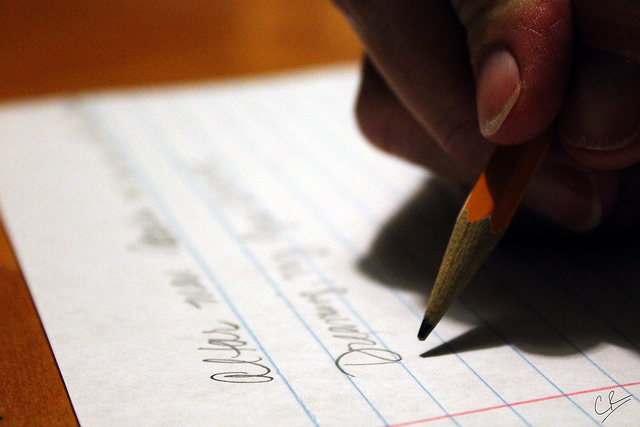
Photo: Flickr/Writing? Yeah.
The post You Married a Writer. first appeared on Jennifer S. White.
]]>The post Why We Should All Be Bored with Overly Emotional, Angsty Articles About Sex. first appeared on Jennifer S. White.
]]>
Lately it seems the articles I come across that are “artsy” are just kind of psychotic.
There are several sites I find my Facebook friends, for instance, sharing words from that, as a writer, I find problematic. After much consideration, I’d like to try addressing this within my writing community.
Because there’s a point where we’re mindfully feeling something—being present within our reality—and then there’s wallowing.
Sometimes an article doesn’t strike me as “deep,” so much as kind of gothic-high-school-nutty. Most importantly, I think if writing wants to be good, then there needs to be a differentiation between what is a heartfelt share of sentiment and what is, frankly, kind of borderline personality disorder-ish.
Our writing should be kept in a deep dark hole rather than published if:
1. We wouldn’t want our kids to read it.
This isn’t the same as writing being uncomfortable because it’s honest and raw, and this doesn’t mean wanting an 11 year old to read something. Still, there is a point when, if we have kids, we need to ask ourselves, is this article about their dad, for example, truly okay to put out into the world?
2. Other human beings do not benefit from this.
Sharing something personal can be beneficial to others because it’s insightful and helps us to not feel so isolated within ourselves; our own feelings and experiences.
There are also other times when writing is more of an emotionally wallowing blurt that could best be written down first inside of a journal, so that it can be processed more completely before being birthed for others to genuinely find the connection and/or lesson within.
3. Is it funny—or is it cruel?
My personal sense of humor tends to be sarcastic. Because of this, I’ve had to check in often with myself about is this funny as a general truth that most other people think or feel, but wouldn’t verbalize—or is it just kind of mean-spirited and hurtful?
Humor shouldn’t have to hurt feelings to be funny.
4. Why are we sharing this publicly?
One of the best ways to get in touch with if an article should be shelved or submitted, is to ask ourselves as writers why we want to share this with our readers.
If the real answer involves attention or “likes” or anything beyond a larger benefit for the community as a whole then, in my sometimes-humble opinion, we should keep it to ourselves until it has more time to become something better.
This article is actually something I’ve been processing for several months and finally decided to share.
I’ve asked myself the above questions repeatedly, and the reason I want to address this as a writer is because, as a reader, I’m getting alternately bored and irritated with being bombarded with words that I think a therapist should be reading instead of me.
But, seriously, there’s enough crap being put out there for us to read. Do we really want to add to it, simply because it’s easy for people to click on, or because we want to do that writer thing of bleeding through our fingertips?
Sometimes writing should have some gauze and band-aids slapped on it before it’s bled out into the world.
Sometimes emotions are not reality. Sometimes mindful living means getting far enough outside of ourselves that we connect with something larger, something broader—something more valuable.
It’s my intention that we, as writers and readers, demand more from ourselves.
We should demand emotion that’s raw and real, but not saccharine and cheesy.
We should demand mindful living and not over-indulging in our internal human experience.
We should demand that journalism and writing be helpful for our world and not money-driven slop that internet trolls benefit from.
We should offer words of benefit because we believe that we have the ability to create an impact.
“A life is not important except in the impact it has on other lives.” ~Jackie Robinson
Photo: Christian Gonzalez/Flickr.
The post Why We Should All Be Bored with Overly Emotional, Angsty Articles About Sex. first appeared on Jennifer S. White.
]]>The post Why Writers Shouldn’t Write Every Story. first appeared on Jennifer S. White.
]]>
I’ve long called my writing genre “stay-at-home yogi.”
This isn’t to say that I don’t enjoy sharing random musings, or writing for various media outlets where I find that it’s best to share these said random musings. But.
But I’m here to offer today that, as writers, we should have an intention for our blogging.
This was recently made all the more clear to me when a reader asked that I consider writing not about motherhood for a change, but about money. Um, no—and bwahahaha! to anyone who knows me in the slightest.
And this also isn’t to say that it’s not easy to fall into this trap of blogging about everything that comes to our minds. After all, blogging is exciting and social media is exciting—especially when it seems that people are really beginning to listen.
I, too, have been guilty of over-blogging.
To be fair, this assessment of my past as a writer and my future of a writer has become easier to appreciate, since I’m currently in full-time Mommyland mode and, for one, being more particular about what I take the time to share on a public platform and, for another, having larger pieces of writing in production (i.e. books) has encouraged me to fully understand how blogging can—and should—be used to further our other writing pursuits—and this is what I’d like to discuss here.
I came into blogging as a natural evolution from journalism.
Reporting for a newspaper doesn’t mean globe-trotting and digging into top-secret stories. Often, it means covering whatever the writer is assigned.
Still, I became appropriately fascinated with news, covering current events and, later on, I found that blogging meant being able to put my own spin on it all (whereas good journalism should contain no personal sway).
However, writers who aren’t focusing on journalism—which is usually the case with blogging—should have a more focused goal for themselves—and a focused genre.
So I’ll use my own example—my “stay-at-home yogi.”
The shortened story is that I was primarily a yoga teacher-slash-writer until having children and moving away from my mother, who watched my kids when I taught.
I saw this move, separation and lack of help coming and began, initially, to write a yoga column for the same newspaper where I was reporting. Then, I gradually shifted into online writing and away from the newspaper scene entirely.
Presently, I consider myself to be primarily a writer and, of course, a mom.
I’m also no different from most writers in that I prefer writing about what I know—which is still my yoga practice and teachings, my children, my life as a parent and my life as a writer and blogger.
My ultimate goal, if I’m being more honest here than I’d actually prefer, is to write books and use my blogging to gain audience for them. (I’m old-fashioned and really find it ideal to shift away from living in front of a computer screen—and books provide this lifestyle with much more practicality.)
Point: my blogging should support my goal as a writer, and I should have a targeted audience with an intended purpose for my writing—anything outside of this can and should be privately journaled and not published. (Here, read this.)
And my own intended audience isn’t just women.
No, the lessons I learn as a parent can be made relevant to all, and I’ve found a supportive readership from men as well as from women, in addition to other mothers.
Still, writing about money—as that one reader suggested—doesn’t fit into my writing world that I’m creating—at all.
Four questions to ask ourselves before we hit submit, publish or share:
1. What is the purpose, intention and goal of my writing?
I’ll share mine: to remind everyone—including and especially myself—that life is made up of little, tiny, seemingly inconsequential moments that make up our lives, and that staying present and mindful as we move through them means not missing out on anything. This also means staying present for those less than stellar moments, and much of my blogging pertains specifically to how to deal with these types of stressors (which is where my yoga practice comes in).
2. Why do I want to share this?
Let me be thoroughly honest here: I see a lot of blogging out there right now that makes me question the intention—and the wellness communities that I typically write for are not exempt.
For example, is this writing self-serving to our ego, or is it written to gain sympathy rather than to actually help other people?
In other words, always ask yourself after writing something: is this helpful to others or is this more of a rant that can be saved for my own privacy?
3. How is social media supporting my writing?
Speaking of over-sharing, there’s also Instagram, Twitter, Facebook, etc to consider, especially as a blogger.
These types of social media can absolutely be used to further advance a writer within a specific genre and towards a wider audience with a specific goal.
Personally, I’ve found both Instagram and my Facebook author page to be great places to connect with readers, while staying inside of the framework of what I find appropriate to share from my life and myself.
4. What is my ultimate goal as a writer?
Now, this can be a hard one, as writers definitely should write because we can’t not write. Meaning, we write because it sets us on fire and the words come and we can’t stop them. But—there’s that but again—as a published writer, where do you see yourself?
As I’ve shared, I see myself as a book author who blogs a bit to stay in touch with the world.
Maybe you see yourself as a yoga teacher who supports and supplements with yoga blogging too.
Ask yourself these questions and if the answers are foggy, then spend time pinning down specifics.
The way that I see blogging and writing is more than a hobby. Writing, for me, is a career.
Because it’s difficult to take a writer seriously who doesn’t take herself seriously. It’s also challenging to find an audience if no one knows what to expect when a new piece goes up. More, blogging is an ideal platform for those of us with many interests and who enjoy quick bursts of creativity—like, ahem, a stay-at-home yogi.
And being a mom has taught me more than I ever could have expected about being a writer.
It’s reminded me of what’s truly important in life, and it’s forced me to reign it in and publish only what is really important for my career because I simply don’t want to make the time to write everything anymore, not with two little kids and one chance to be mom.
Ironically, this blog is a little bit of everything on this subject—but my goal and intention here is to open up some discussions between writers and the blogging community as a whole, because this is the reality of being a writer in this modern age.
Self-publishing, blogging and connecting with readers on social media are ginormous parts of the life of a writer who wants to share her work in a public manner.
Still, the writers that I keep coming back to read again and again are those who give me insights into myself by sharing little snippets of their own discoveries, whether fictionally or not.
After all, we are not writers because we are gifted with words; we are writers because we are gifted with observation.
Photo: Flickr/Drew Coffman.
The post Why Writers Shouldn’t Write Every Story. first appeared on Jennifer S. White.
]]>The post The Only Way to Cure Writer’s Block. first appeared on Jennifer S. White.
]]>
To be fair, I haven’t exactly had writer’s block.
What I have had is a complete lack of concern for my writing.
This isn’t to say that I’m not still constantly jotting down ideas at random when a reflection comes to me, or making notes with my iPhone as I’m stopped in the preschool pick-up line, or even mentally clustering together my upcoming writing projects—but I have been residing almost permanently in Mommyland.
Because I might be a writer in my soul, but I only have one shot at this mom thing. One. One chance to raise my children.
I have one chance to react when lunch spills all over the floor. I have one chance to hold her hand at six months old, and then at two, and then at four.
I have one chance to be a mom.
But being a writer makes me a better mom; being a writer encourages me to sit down with myself and to explore—both things that serve motherhood well.
So I might focus on exercise and staying physically healthy to carry around and dote on my kids, but I can’t ignore that I’m a writer, and I don’t want to.
That said, we, as writers, do get out of our grooves.
Sometimes it’s a shift in priorities, like I’m experiencing right now, and others it’s an actual shortage of words for the balmy breeze of life that blows through us; as we experience living and then try to place it into corresponding syllables and punctuation.
Last night, I was out walking in our new yard with the baby. (We’re in the middle of a move—I sit surrounded by boxes as I type this.) My husband and oldest child were inside getting evening baths while I spontaneously put the baby in her carrier and strolled around our expansive new property.
I stepped somewhat cautiously around the perimeter and inspected the way a cluster of wild purple flowers played underneath the orange and yellow setting sun.
I admired how the yellow of our new house matched almost perfectly the sky through tree branches.
I noticed that the leaves of these purple flowers had red around them.
My baby held my hands tightly as she also looked outward and ahead, although she was strapped to my chest instead of feeling the grass tickle at her feet.
Her tiny fingers curled around my normally small, now large ones and she giggled in a way that let me know we’d be holding hands like this when she was toddling alongside of me, still looking at how the yellow sky meets the grass-covered hill.
And I gave myself permission to show her these things.
Because when a child comes second, there’s an overwhelming concern to make sure the eldest feels loved and cared for as well. This isn’t entirely selfish for the first born either. No, if we want our children to grow into friends as they age, then there should be a shortage of insecurity and jealousy and an abundance of love and a nurturing of bonds.
But last night as I walked the purple flowers and spring-green grass, I gave myself permission to want to share with her all of the wonders of this world, like I have done with my first baby.
The three of us—my two little girls and I—walk the yard regularly since we began this transition into our new living space a few days ago. My four and a half year old walks joyfully and sometimes slowly.
She stops and takes in a car driving by, noting it’s color and from which direction it came, before predicting the next one’s color and direction and moving on to study something else.
She looks at the way the yellow dandelions move when a wind comes through—she really looks.
And as I walked through the yard last night with my thoughts and the baby, I wondered, when did I stop really looking?
When did they just become yellow flowers all over and not something to behold with exquisite curiosity?
Because when life becomes overwhelming, it’s human nature to glare so far inward that we lose our innate sense of direction; we lose our place on the road, with all of the other cars driving alongside, if we focus too much on our own ten o’clock and two o’clock. It’s only when we are able to come back into taking in the scenery around us that we can again remember who we actually are and what we might be here to do and share with life’s other passengers.
And we cannot write if we are too wholly immersed in ourselves.
Writers create from an intense wonderment of the world; of people; of life. So when writing stalls, whether temporarily for a day or, like mine, for an indefinite period, it’s imperative that we continue to nurture what makes us writers in the first place.
We are not writers because we have the gift of words—we are writers because we have the gift of observation.
And as the baby giggled in her carrier, watching a bird fly overhead, and I wanted so desperately to take these thoughts and make them into black and white letters, I knew that, even though I might not live a writer’s life right now, that this new house and these two new souls growing alongside of the yellow dandelions, would provide me with all of the inspiration—and words—that I would ever need.
Photo: Author’s own.
The post The Only Way to Cure Writer’s Block. first appeared on Jennifer S. White.
]]>