The post The Caged Girls: A Billion Steps Back—How to Trust Enough to Fail. first appeared on Jennifer S. White.
]]>Part Eight of The Caged Girls: A Billion Steps Back—How to Trust Enough to Fail (Chapters 25-28).
Chapter 25.
I decided to overcome my eating disorder once and for all because I wanted to get pregnant, and I had no desire to pass along my terribly unhealthy relationships with food and my body to a child.
This is not to shame, blame or guilt any mother who suffers; this is a reality of our world—living in cold, dark cages and not being able to get out, even when we’re raising children—even when we’re raising daughters.
Still, it wasn’t an entirely unselfish decision, my desire to be rid of my anorexia before expecting a baby.
For one, I longed to cherish, adore, welcome and be admirable of my growing body, not disgusted by it. I’ve known far too many women who were hung up on the pounds gained and where and how their bodies changed rather than focusing on the fact that we’re forming a new life!
And yet the first time around, when I was pregnant with my daughter, I pushed myself to exercise when I didn’t feel like it and I ate like a homegrown picture of perfection—although I did enjoy myself and my garden-produced food—but I didn’t let myself truly relax into my pregnancy.
I don’t regret it either—giving birth is the ultimate exercise. (My abs were sore with lactic acid build up for days afterwards.) I gave birth naturally—never having so much as a Tylenol during my pregnancy or her delivery—and when I see women letting themselves get horribly out of shape and eating like anything but the health warriors that their bodies are calling on them to be, I feel sad and I can’t help but wonder how that labor will go.
But we can’t see the future—complications happen, plain and simple—but what about the ones that we can prevent or help to ease along?
My body is a machine; my body is also my cozy, warm, quiet, safe home—my body is both of these things and I wanted to figure out how to treat it equally in these two regards.
Let me admit, this is not easy. We’re conditioned to think in one way or the other—our physical selves as round, supple, womanly places of worship or as rigid, muscle-rippled, health machines. So what I’m asking—and what I asked of myself—is why can’t we be both?
Why can’t we have our cake and eat it to?
So I set on a long, arduous road of keeping ice cream in the freezer but not eating it—or, more importantly, even wanting it—every evening.
I set out to exercise and keep my body in top shape, but not to the point of obsession or ruthlessness with myself. And this is what I learned: when we go to either of these extremes—shunning our bodies as health machines or accepting them in full as such—we are avoiding who we really are.
We’re avoiding our fear or our hurt or our life in a multitude of ways when we don’t allow ourselves to sit still and eat something for the pure sake of flavor; instead heading to the gym or for a walk outside for the second time that day (or third, or fourth, or fifth).
Simultaneously, we’re avoiding our primal need to be strong and to be able to endure life when we sit around and avoid exercise because sweating in a yoga class might mess up our hair or make us have to shower again.
In short, we can’t be recovered from an eating disorder until we learn to accept these extremes and then to couple them together into softer versions. I know this is a huge claim, but I’m standing fully on it—because it’s true.
Chapter 26.
I see so many women claiming recovery when they’ve basically lapsed and gone the other way.
For example, if bulimic, there’s a sense of pride in being able to portion food with extreme amounts of care—and control.
If anorexic, there’s a sense of intellectual fulfillment in watching the scale tip the other way and in eating things previously deemed “off limits.”
What I’ve also witnessed is how these behaviors then usually go to an unhealthy extreme too, causing a set-back or a full-on relapse.
Because part of the life of a recovering eating disordered person is taking five billion steps back for every step forward—and it’s more frustrating than it sounds, which is why many people just give up.
What I’m telling you is this: don’t give up.
The world is filled with people who want to jump and leap and soar forward without ever going backwards—and this is not success; this is not the path to success.
Every successful person out there will tell you that learning to accept failure and defeat is an absolute must if you plan on being a champion in whatever it is you seek. You have to invite failure, actually.
When I started keeping ice cream in the freezer (in—gasp!—quart-sized containers) I would eat so much that I would feel sick to my stomach, but I knew that I had to continue keeping it there, because if I took it away and vowed to never eat ice cream again—as I had cyclically done for years—then I would never learn how to have only a little; that I would never truly heal because much of healing is trust and much of self-love is self-trust.
We’re animals and we’re programmed for feast or famine. I see this even in my daughter.
If she knows that she can have something tomorrow, she’s more satisfied to have only a little bit today, but if I take it away and ban it, then she wants to hoard it when it’s around. (Not that our kids can always choose their diets and portions, but this type of behavior is learned early on.)
And by this type of behavior I mean, partially, learning what’s a “bad” food or a “good” one, rather than keeping foods as merely what they are and discovering that we simply feel better when we consume more of this and some of that in moderation.
But the anorexic and the bulimic don’t know moderation anymore—they’ve programmed themselves into only an extreme and they inhabit entirely that land of do’s and do not’s and of famished and of bursting.
And we’re using food control or lack of control to equal out our emotional selves—which is why we first need to take emotional attachments and judgments like “bad” and “good” away from food.
Chapter 27.
The first time I publicly acknowledged my eating disorder was in an article for elephant journal titled “How to Overcome an Eating Disorder in 6 Steps.”
In it I detailed and defined six critical steps towards recovery.
What interested me was the amount of positive feedback that I received and how many views it got from readers, but how little it was shared.
It interested me because people don’t want to “share” their eating disorder on Facebook. Nope, they want to share a cutesie photo of desert at a gourmet restaurant or a picture of themselves rocking out a fancy-looking yoga pose, which is definitely understandable. People don’t want to place the ugly and stigmatized parts of themselves in public, to be dissected and possibly discriminated against for it later.
And there’s nothing wrong with this—but we’ve become a culture of either over-sharing or over-sharing phoniness.
And it was after the publication of this particular piece that I decided what my writing genre would officially be: writing about—and then publishing—what people need and want to hear but are too afraid to outright admit and ask for.
Chapter 28.
How to Overcome an Eating Disorder in 6 Steps—yes, this bold title was meant to lure people in, but it’s bold because I believe in this process, not because I’m trying to become clickable in an already click-saturated online sphere.
And here’s what I subtitled that blog:
Or, rather, how I overcame mine.
And my six steps of recovery look like this:
1. See food as medicine. On your quest towards leaving your food-is-the-enemy mentality behind, see food as medicine. After all, food nourishes your body in a way that nothing else can; it is medicinal. As a foodie, I totally get that food is so much more than this; it nourishes so much more of us than just our bodies. Yet someone with a severe eating disorder is likely incapable, at least at first, of understanding this. Trying to get them to see food as love or anything spiritual or special is beyond the scope of reality. Hopefully this will come with time and healing, but focus first on not seeing food as something to fear.
2. Eat when you’re hungry, stop when you’re full. It’s not just the people with eating disorders who have stopped listening to their bodies. Our society as a whole does not prepare us for a life of eating when hungry and stopping when full. I’m not only talking about the clean plate club either. I’m talking about that one hour you have to eat lunch or that window of opportunity to give your kids breakfast before school. I’m talking about the no you can’t have that before dinner rule. Let me tell you, it took literally years to re-learn my body’s hunger queues, and at times I had to quite seriously fight my bosses to eat when I needed to (I won). This reconditioning takes patience and practice—and, trust me, it’s worth it.
3. Stop using the F-word! Fat. It’s become an ordinary part of our lexicon—and this sickens me. I don’t believe in saying never, but I will tell you that I will never call myself fat again—especially in front of my daughter. Please, even if you think it, stop saying it. Not only are you allowing the cycle to continue for your kids, you’re allowing it to continue for yourself. Ever heard the concept that thoughts become words and words become actions? There is something real in this. Sometimes we have to fake it to make it, so I’m begging you to stop using the f-word.
4. You always have the potential to become sick again. I was severely eating disordered for well over a decade, for definitely half of my life thus far. Yet I don’t see myself as eating disordered at all anymore. Ask anyone who knows and loves me; I love food and I eat extremely healthfully, yet I still eat what I want when I want (and I don’t over exercise anymore either). But you know what? Some of my absolute worst periods came after I had mentally declared myself eating disorder free. Then it dawned on me that I’m more like an alcoholic: I can be recovered, but I’ll always have an eating disorder. Maybe you don’t agree with this philosophy, and this might not be true for people that haven’t been severely ill with this disease, but I fully believe that seeing myself as having the potential for a relapse is what’s kept me well for the last decade. Sure, there’s some negativity behind this, but it’s the harsh reality for some.
5. Treat yourself like a beloved friend. In some cases this might not work, because some people don’t know how to treat other people with love and compassion. However, this step really helped me. I first read about this concept—talking to yourself like a dear friend—in a book during college. Would you say some of the things you say to yourself to someone you really loved, or would you treat them with more understanding and forgiveness? Being objective in this loving manner is a huge step towards the ultimate goal of health and self-love. (And this is true for everyone, not just people suffering from an eating disorder.) Remember that thoughts become words and words become actions—so start demanding that your inner voice speaks more gently.
6. Practice yoga. If you already practice yoga, great. If you don’t, start. Granted I had been practicing yoga for years—as a stretching routine after a run or weight lifting session. However, when I finally tuned into a daily yoga practice, I discovered so much health and ease and love for myself and for my body. Practicing yoga has helped me overcome a myriad of physical problems—from chronic low blood pressure to SI joint pain after childbirth—and you know what? I credit it for saving the real me that had to live inside a sick person. So thank you, yoga.
If these steps seem too easy to be true, it’s because they are. Just like anything else, you can be shown how to do something but it takes your own work and practice to be successful.
Recovering from an eating disorder is possible.
For many years, I defined myself as an eating disordered person first, who happened to have other qualities. Now it’s not even part of my vocabulary, much less my self-definition—and it took many years and many setbacks to achieve this.
So how do you overcome an eating disorder? One small step at a time.
Photo credits: Author’s own.
The post The Caged Girls: A Billion Steps Back—How to Trust Enough to Fail. first appeared on Jennifer S. White.
]]>The post The Caged Girls: Yoga Pants, Sticky Mats & Freedom (Chapters Six Through Ten). first appeared on Jennifer S. White.
]]>Read Part Two of The Caged Girls: A Life in the Mind (Chapters Four & Five).
Part Three: Yoga Pants, Sticky Mats & Freedom.
Chapter Six.
I look down the length of my slim legs, covered in orange and purple, sunset-patterned yoga pants.
I plant my hands shoulder-distance apart and reach my right leg long behind me, hugging my left thigh in tightly. I press up into this hugged-leg variation of handstand and hold it for almost three breaths before coming back down.
My daughter catches me watching her as she prepares to practice her own three-legged downward dog on her scaled-down, matching mat next to mine.
I’m overjoyed in a way that I’ve never felt before—I can’t believe this tiny lady actually wants to practice yoga with Mommy—she asked me—and I’m frequently in awe of the fact that I love this practice, in general, so much.
I was never an athletic kid, like my little girl. I was not a person who relished sweating and panting and team-played sports—I was not this person until I found yoga.
Sure, I swam and I ran and I hiked and I exercised, but I never authentically enjoyed the sensations of physically moving within the structure of my body, the way that I do when I’m in clingy leggings on a sticky mat.
Returning to my practice, I move and breathe and flow and, alternately, observe my mini yogini out of the corner of my eye.
Inhale, arms sweep up—she, too, reaches arms high, only their relative shortness to her head makes her wonder if she’s doing the pose incorrectly, so different is hers from mine.
Exhale, forward fold—she comes down to her knees and looks up at the television screen, where another seasoned yogi is giving us our cues.
Inhale, halfway lift—she takes a break and plops down in front of her primary-colored piano.
Exhale, step back to downward-facing dog—she returns my gaze and hops onto her tiny mat to rejoin me.
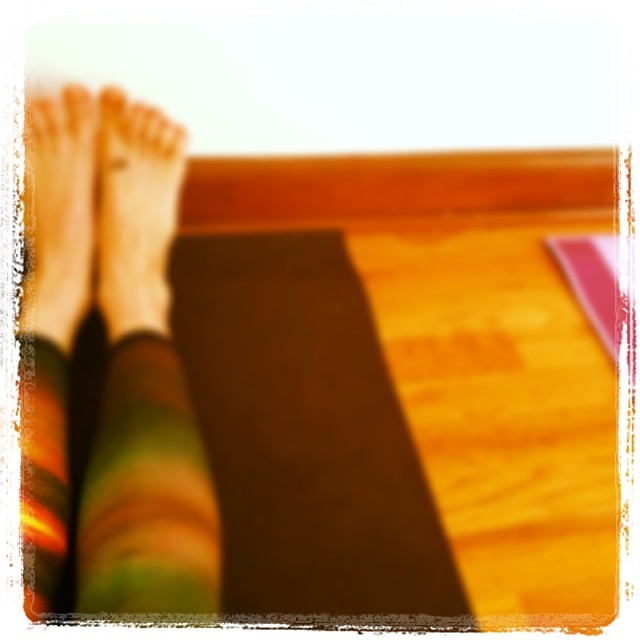
After our physical practice is over, I make us three slices of peanut butter-honey toast, cutting gooey bite-sized pieces up for her. I have a coffee in my green ceramic, handle-free mug and she drinks mango juice out of her sippy cup—the one with her name in bubble letters on the side for when she takes it to preschool.
She wanders over to the blinds and shifts the curtains just enough to open and close her small fist—waving and saying hi to her daddy shoveling snow.
The ease with which these two exchange their love leaves me feeling like an outsider.
I move intentionally from my own finished-practice kneeling position to child’s pose; my forehead resting on the firm, waffle-textured rubber mat.
I’ve shifted here because I feel tears welling up from behind my eyes and I don’t want her to see them spill over.
I don’t cry easily—I have luculent day dreams of violent wailing because I know how good it feels to cry. Instead, I’m the woman with red, puffy eyes looking away from the grocery store clerk ringing up my kefir and beer because my body chose to let go in the middle of a day full of errands.
My breath hitches—no longer the smooth, skillful yogi—and she moves swiftly from behind the parted curtains to standing in front of me on my purple mat—our purple mat. She takes my hair in her left fist and tugs. I resist—she’s trying to make me look to her, to see if I’m okay.
Although a toddler, she’s authoritative—I think I’ve mentioned this—and, before I can help it, my wet eyes have met her confident ones.
My breath slows.
Inhale.
Exhale.
Inhale.
Sigh.
I hear clomping foot stomps on the wooden porch on the other side of the large front picture window—those panes of glass the only things separating our purple sticky mat and him.
I inexplicably recall something that he said to me after I’d finished writing my first book.
He’d loved it—truly—but he said that he was disappointed I hadn’t written more about my yoga practice—he thinks it’s a major part of my life, of who I am—and of who I’ve allowed myself to become.
He opens the front door and embraces our just-above-the-knee person, clinging to his snow-covered pant leg.
We talk for a minute, and then I take my green ceramic mug into our bedroom. I close the thin door and open my laptop’s two hard pieces of plastic, resting on our bed’s turquoise quilt.
I look down the length of my slim legs, covered in orange and purple, sunset-patterned yoga pants…
Chapter Seven.
So the reason for my child’s pose, purple mat tears yesterday was that he and I had a fight.
But not just any fight—one that I started.
While I don’t get off on fighting, I also won’t avoid it—it’s a necessary evil of both a strong relationship and one composed of two strong people—which is why we work so well and have for nearly 20 years—because we won’t let ourselves be bulldozed by the other partner, but we’re in love and compassionate and compromising.
Sometimes, though, I feel like I’m not meant to be around others.
I see myself curtained—cocooned—in sheer, white tulle that canopies my beckoning mattress—my siren—in the middle of the forest. My familiar turquoise and brown-textured notebook is there, along with my preferred ballpoint pen. I’m not wearing phony fairy wings, but I’m equally not my same, assumed human form.
It’s quiet here—completely still—except for a light wind ruffling the tree branches high overhead, but not my loose brown hair (because of the translucent curtains). It’s soundless, too, except for a swaying breeze, coupled with a hidden source of falling water (so soft that it’s almost inaudible, but it’s loud because of this relative silence).
And I’m alone—but nestled deeply within my breast is the critical knowledge that I’m loved—and that’s when my sheer, white, gauzy curtains part and I peek out from my self-imposed wilderness to see, on the other side, my light-colored wood floor waiting patiently—and my red microfiber sofa waits too, littered with stuffed animals and soft Disney-themed blankets—and I know that I’m not meant to be by myself after all. I just need some space once in awhile.
To breathe.
Chapter Eight.
I was always slightly terrified to have a baby girl.
Obviously, I was elated and excited—tiny nails to paint, little jewelry items to make especially for her—but there are so many other aspects of womanhood that, put simply, aren’t easy.
I consider myself a strong woman—often obnoxiously so. However, even the most resilient, refined women will encounter discrimination, prejudice and difficulty within the walls of society’s birth-gifted pink and metal cages. I don’t mean to place a lack of importance on how far we’ve come or on how much work and determination it took the women before us to get here. Still, we have a long way to go.
Yet the thing that surprised me most about mothering an infant daughter was that nearly all of my concerns flew out an open window almost immediately after she was born—because she is truly her own tiny lady and, in many ways, she’s nothing like me—and then these previous worries were replaced with new ones. She would have her own, separate battles and I would have to learn to see her and her life through new eyes and not those of my own prior experiences. (Easier said than done.)
For example, when I’m hurt or upset I lash out aggressively. She, on the other hand, holds things in—the epitome of a velvet-gloved fist. Also, I love food, was never a picky eater and had to learn to balance enjoyment and health (and all of the various combinations of these two where diet and my body are concerned). She is, contrarily, a horrifyingly picky eater and she does love food, too, but she—even at age two—never hesitated to leave the last several bites of chocolate cake on her plate—or refrain from eating it entirely if she wasn’t interested. But, don’t be fooled—the strongest differences between us have largely nothing to do with her and everything to do with me.
I spend much of my time as a mother battling my own intricate personality, so that I might spare her from being affected harmfully and unnecessarily from it—from me.
She’s naturally easy-going and charming and I—while, ahem, surely, charming myself—am not such a text-book definition of an ideally placid temperament.
I wrote my first book for her, actually—it was my first birthday gift to her.
I wanted her to have deep insight into my long-term relationship with her father as well as into my complex inner-workings. And yet.
And yet.
One of our most interesting discrepancies is that I’m clearly a word person and she doesn’t seem to need them much. She’s better than my words will ever be—because she’s absolutely, one-hundred percent filled with heart.
I’ve met a lot of different people in my life and none of them, regardless of age or gender or sex, have ever been as appealing soulful, intuitive or filled with some quality that I can’t even find a word for.
Her spirit is just huge—it’s ginormous. She’s gigantic.
She’ll never fit inside of a cage—and it’s my job, as her mother, to repeatedly keep giving her the keys to get out if she happens to ever be placed within the confines of one—either by herself or by another—and it’s my job, equally, to help her remain free—as free as she is right now tugging on my sleeve and handing me her pink coat to head out for a new Mommy and tiny lady adventure.
More, it’s in my best interest to not forget how much she has to teach me—and that sometimes it’s more important to listen than to find the right words to offer in return.
Chapter Nine.
Volcanic glass quakes and churns and boils within the central core of my being.
My eyes want to glaze over, my hands want to dig into hair and tears beg to flow down my bent legs, hugged closely into my chest.
The burning of all the things I want to say eats a dangerous crater near my heart.
The words that I let erupt, though, are all wrong and make everything worse—they make me worse.
Occasionally, a chunk of my volcanic-glass soul breaks off and, in it, I see who I am.
They say that obsidian—true volcanic glass—offers a person insight into her authentic self, even though this glimpse might not be what’s desired.
But my volcanic heart shows me enough.
I tried so hard today to be a good mom.
Today was a day full of special, little things intertwined together in an attempt to make a little girl happy. And yet today was the kind of day when nothing seemed to work. Each little moment was accepted and enjoyed graciously, but every waking second filling the gaps in between—what I like to call life—felt as poisoned as that ill-fated apple—I felt poisoned; polluted.
My chest expands and becomes concave as my breathing settles into normalcy and my fingers dance across my laptop keyboard.
This solitary confinement—in my bedroom with my space heater as white noise—loosens my volcanic core, but my sun—my beloved, occasionally overwhelming child—has begun to set for the evening and my heart now feels brittle and cold as ice.
And that’s the thing about motherhood—we’re not entirely free to be ourselves, because we should be cautious and courteous about what’s best for our baby girls.
Although it’s in her best interest, certainly, to have a mother who expresses her own feelings and who encapsulates a real human being, it’s also more than appropriate to maintain some sort of acting ability, for the sake of her own tender emotions.
Yet I think that’s the other thing: I’ve never exactly been a tender sort of girl.
Yes, I’m tender and fragile and wildly soft in many ways typically feminine, but I—like many young and old girls—am also wildly fierce and strong and capable entirely of masculinity—more so than many men—and why should we be so contained within our girlhood to not explore this…bitch?
Regardless, I feel myself closing down for the night. The entrancement of playing this mothering game has been more than enough for one day; while I need my turn to dance with my alphabet-littered keys, I wouldn’t dance with any other partner so often as I do with her.
Chapter Ten.
She sticks her wriggling arm through the puffy, pink jacket sleeve.
She’s determined to get her coat on all by herself.
She has the wrong arm in the wrong sleeve, but I don’t tell her. Instead, I type a few more words and let her see this puzzle piece for herself.
I tip my head to her again and see that she now has the correct arm inside of the correct coat sleeve. I sportingly hold out the other one so that she’s able to slip her tiny hand inside. She does and now she’s fiddling with the cold metal zipper.
I start the zipper at the bottom for her and listen to her struggle and whine a little in frustration, but then she stops and I can hear her talking herself through it—she has more patience as a rightly frustrated toddler than I do as a thirtysomething woman.
She giggles and I see my two favorite dimples in the world light up the room.
Her zipper—pulled up high enough for her satisfaction, although it’s barely to the middle—has lost it’s appeal; with her coat now completely on, she walks over to her pink and white table to grab her blue fedora-style hat and then struts mindfully over to the rainbow-medley carpet by the front door for her boots.
I hear little spurts of coat-rubbing-against-coat activity and uh’s and umph’s and hhha’s as she plays with getting on her shoes. Then I hear clomp-clomp-clomp as she pitter-patters over to me; lone purple boot in hand.
One shoe on, she’s trying to put a second pair of florescent pink fleece pants over-top her jeans. (Apparently, she thinks we’ll be taking off into the rather arctic Midwestern winter temperatures.)
I clickity clack on my keyboard for one more second before I realize that it’s time to hit save and close my laptop’s hard plastic covers—because words will never be the most important thing in my world, even if I can’t live without them.
And then the searing memory of that debilitating, all-encompassing pain—of when I thought I was going to lose her—moves from my mind to my stomach to my bones. No, there’s only one thing in this world that brings absolute joy, light, healing power and health—and that’s love. (Although yoga pants and sticky mats don’t hurt.)
Photo credits: Dominic Robinson/Flickr; tanahelene/Flickr; Author’s own.
The post The Caged Girls: Yoga Pants, Sticky Mats & Freedom (Chapters Six Through Ten). first appeared on Jennifer S. White.
]]>The post The Caged Girls: The Prologue Through Chapter Three. first appeared on Jennifer S. White.
]]>The prologue.
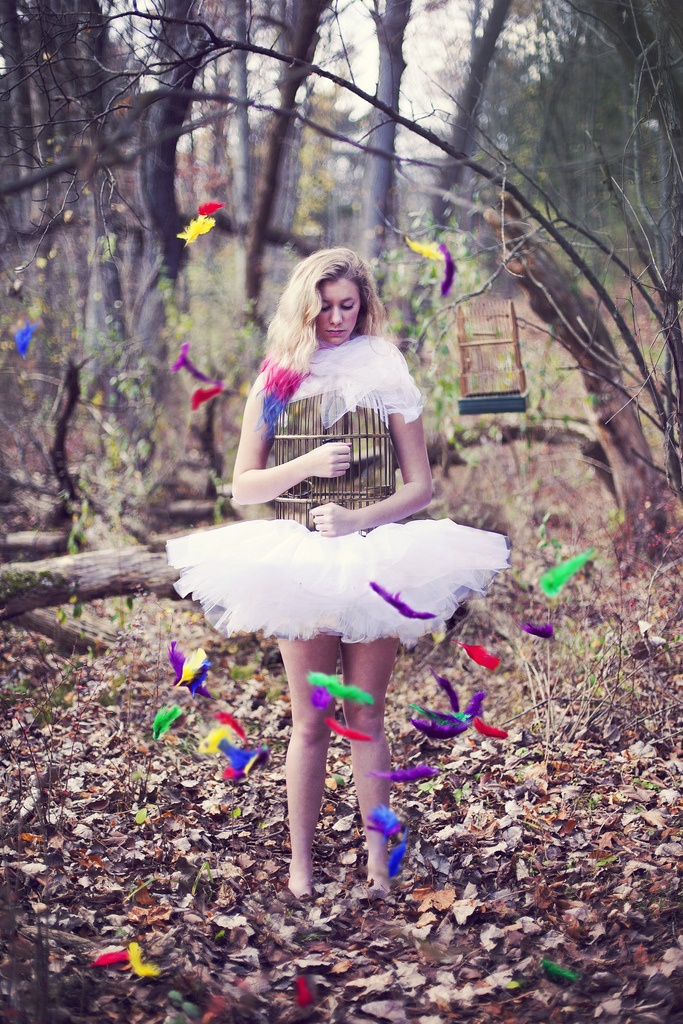
My body used to be a cage.
I used to claw and worm and wriggle and starve myself to fit through its bars.
Because the real me was trapped inside. Desperate. Aching. Lonely. Fearful.
Angry.
I was angry that my huge, bright spirit had to be contained within such a simple, limited form—and I didn’t accept these limitations, so I fought them.
I fought them for years. I fought with everyone around me too—it was their fault after all; their fault that I was too big to belong.
Because not all of us can be small and tiny and delicate, even though society wants women like this. No, some women are bossy and domineering and crude and loud and hilarious and, by default, manly.
And men are expected to be big and bright—actually, men are held within cages when they aren’t big enough—but I was a woman, and I was supposed to play the part. And so I did.
I threw away my careful, mother-packed brown sack lunches in the ugly, grey trash bins in the junior high cafeteria. Or I kept them on the top shelf of my locker until I had a week or two’s worth of rotted lunches and pitched them all at once, somewhere quickly and quietly.
And I needed to be quiet.
Not loud. Not boisterous. Certainly not unstoppable.
So I stopped myself first. (Which gave me a fictitiously dangerous semblance of control.)
I—so out of control, however—would be sent to the school nurse’s office to lie on the cold, hard “bed” with horribly low-count sheets because I was too emaciated to have the energy to sit through class; nearly passing out (so out of control was I).
I went from a cheerful, silly, large girl to a frightened, tiny mouse—not a person at all, much less a girl growing into a lady.
But I was never physically large. Sure, I was chubby enough to be picked on by peers. I loved food enough to not understand the children who got up from the white Formica tables to throw away their mother’s deserts.
I read my mother’s hand-written I love you notes every day; stashed inside those careful brown sacked lunches. I collected the Suzy’s Zoo stickers—inside too—within a photo album, behind clear cellophane.
And I felt loved. But I knew I was too big for people besides my loving mom.
Because I saw the pretty, polished things that I was supposed to be.
I already knew movie starlets with sweet, low voices and coquettish, comely charms.
I knew that I wasn’t a girl, because girls were supposed to be nothing like me.
But then I grew angry. I became livid. Because I was a woman. Suddenly and overnight. The starvation didn’t stop my breasts—entirely. It didn’t stop my hips from widening and my heart from expanding in its need for love that was different than my mother’s.
I hated the boys I went to school with because they were allowed to be big and brash and happy. They were encouraged. They didn’t have to shrivel up and whither in order to fit within another’s deplorable pleas to be better than you when they really weren’t.
So I shouted. I screamed. I grew. And I grew. And I breathed fire breath. Until I met him.
He saw me on the front porch and around him—from that first instance of awareness—I knew, once more, that I was not a man, but a woman with girth.
Around him I was huge—and he let me be. Because he, too, was big enough to not have to squash me underneath his own smallness.
So he slipped me the key, between the bars that had contained me for many, many years. I gingerly opened the door and I wouldn’t come out. He waited patiently on the other side, sticking his hand in to hold my tiny, gaunt one.
He would occasionally crawl inside my bed, and bury himself underneath my coarse, starched covers; sleeping on that cold, hard “bed” with me, so that I might not have to sleep alone anymore.
And he lured me out—with the prospect that I didn’t have to be invisible anymore. He could see me—and that was enough.
We walked through the high school hallways together and I, for awhile, was his muted shadow; the one he laughed with and played with and fed, but that others couldn’t see.
He brought me back to life.
His firm, young man’s hands were electric paddles that restarted my flatlining chest.
His lips were Snow White’s kiss—only I would never have to be a Snow White.
I would never have to be fair and cute. Or quiet. Or tiny. Ever again.
My body used to be my cage. Until I outgrew it.
I held onto that cage for sometime. I would peer inside and want to visit it again and again, for stays of different lengths. Of course, I had to be darling Alice and eat the right things in order to fit back through that tiny door.
But every time, I would hear a knock on the hollow metaled bars and finally one day I couldn’t fit back through the door anymore. No matter how hard I tried—because I didn’t want to anymore. Because I wasn’t angry anymore. And I wasn’t sad either.
No, I was, for the first time, able to understand that being caged wasn’t my place. I didn’t belong there. I never had.
I’d been used. I’d been wronged. I’d been treated reprehensibly—by myself.
And, yes, he’d given me the key to seeing myself through the eyes of love, but I couldn’t live behind his glasses. (He wears a different prescription.)
Instead, I had to accept my limitations. I had to accept that I might never have 20/20 vision. I had to become okay with my largeness. I had to own, in short, my voice. If I didn’t, who would?
He left me. Several times, he left me.
He couldn’t keep crawling into my bed. The sheets scratched his tender skin, and my caged heart—so perfectly quiet; so perfectly cold—froze him.
And he realized he couldn’t free me; that all he could do was be locked up with me—and he didn’t want to live inside of a cage.
Because he was too big and he knew it.
He left, but he came back, for stays of different lengths.
We didn’t know it then, yet inside of that jail cell we had become chained together, and we would throw the keys at each other so hard that we had scars, but, no matter what, we would still wind up chained.
My body is a cage I’ll be locked in forever, until my death.
My body is not my cage, though—it’s my home.
As it turns out, all I needed were some softer sheets, a few mirrors and permission from my jailer to visit the grounds from time to time.
My jailer?
I’m my own jailer; I’m my own master, too.
And, like him, I was too big to fit inside the one that society had placed me, after I was swaddled in pink and handed to my mother.
So I threw it away. (Honestly, I burned it—and I tattooed a blue phoenix on the body that rose from those once-jailed ashes.)
And then he and I were handed a pretty, tiny bundle—wrapped up in pink; while I kept these pink sheets for her, I painted her walls blue.
(Oh and I’m handing you the key. And when you get out, promise me to burn your cage and give this key to the next caged girl, until we are all standing together amongst the burning smell of metal, big loud and free.)
I lie in savasana and I realize something so profoundly life-altering that I begin to feel the intense need to sob—the kind of weeping that’s desperately unattractive.
Eyes swollen.
Eyelashes clumped together through wetness that looks out to the world as though from behind a Vaseline-smeared lens.
Body shaking. Soul pounding. Heart-wrenching. Not-okay-gut-grinding sobs.
But I don’t.
Instead, I lie there, moving just slightly more than usual—a twitch of a finger here, a slight rotation of a wrist there—and it isn’t until my teacher kneels over me and, with the gentle, loving, circular motions of her softly padded thumbs, begins to anoint my temples and forehead with a soothing blend of essential oils, that a slow, quiet trickle slips past my dry-fringed eyes.
And while I’m no longer caged, I’m not free either.
Not yet.
Chapter One.
I look down at the pool of water collecting in my belly button.
The water is see-through but orange—a strange swirl of the red and yellow water-coloring tablets that my daughter had gotten from a friend for her third birthday.
Our legs are intertwined and I observe our identical feet, with hers resting delicately—yet authoritatively—on top.
The orange-and-yellow-swirled water cascades down the front of her head, dripping into the crevices around her eyes and moving fluidly and easily through her loose, brown curls of hair.
She giggles so deeply—so richly—that anything outside of that moment—of her sunny smile and her throaty laugh—is instantly lost to me—all that exists is this one small space of time within this bathtub.
She points to my ankle and makes an “O” shape with her mouth, to indicate her curiosity of its official name.
“Ankle,” I say. “Mommy’s ankle,” I over-pronunciate.
She laughs again—this time at seemingly nothing—just life is worth a good snicker. (Or maybe it was my own smile, directed at her, that is being reflected back—like the smooth, glassy surface moving around our naked bodies in the bathtub.)
I look down at my belly button ring—a faux-diamond studded, miniature disco ball of sorts—and envision myself pregnant.
(I’m not pregnant, but I don’t know this yet.)
I look down and see the gentle rise of my stomach—that obvious, slightly dome-shaped swell of my abdomen—and I’m even happier, if this is actually possible.
And I realize—in this split second within that bathtub with my daughter—that I’m ready for another child; I’m finally ready.
After everything we’ve been through together, I wasn’t sure I’d ever truly be ready—but I am.
And it’s my second chance—I realize this too.
Not at parenthood—the sheer perfection of my gorgeous, darling girl is one reason I felt already completed after her birth and, subsequently, challenged to desire another. Rather, it’s another chance…at me.
I decide to write a book called “A Second Chance.”
I sit down at both my slightly gouged, nicked dark-wood dining table with my laptop and, alternately, in my childhood rocking chair—the one that my husband put skateboard ball bearings in a few years ago—with my turquoise and brown textured notebook and a simple ballpoint pen.
The words are lodged within me like empty, unformed, quaking crying episodes—like all of those tears that I’m too exhausted to shed. I bottle and cork them up, with a hand-written rescue-me note inside, and I seal it within the tomb of my caged heart.
And this profound, life-altering realization came upon me as quickly and wildly as a slap in the face—an emotional sucker punch—I do want a second chance, but with her—the one I already have—and with me.
Chapter Two.

The cold, black infiltrates my bedroom window.
Impatiently I stare at the too-bold moon, creeping inside my turquoise bed like an uninvited stranger; a straggler; a tempestuous outcast that I both despise and feel unfairly—and incorrectly—aligned with.
The family heirloom ring that I religiously wear on my right hand slips and tilts to the left slightly as I clickity-clack, clickity-clack on my laptop keyboard.
The translucent skin of my thin hands is marbled with blue and green veins beneath it, and the chill of this wintry air is felt from their tips, up to the tip of my nose. My rigid spine is lax and droopy, but just at the shoulders—slouched over my work and made unusually small by my wilting heart.
Stiff—I’m made stiff by my caged-girl status.
She sat at the white Formica table, a schoolgirl of barely seven, with her brown sack lunch in front of her, spread out on a thin paper napkin sent from home, along with a sandwich, a juice box and packaged desert.
She unwraps the clear cellophane—tearing open one corner—and peeks over her shoulder at the girl diagonally seated from her, eating kiwi and talking loudly.
She feels loud inside—like the girl seated near her—but she feels small—invisible—here at this white Formica table.
She throws the empty plastic into the grey trash bins perched in the center of the room where an unhappy, middle-aged woman monitors the students’ discarded waste thoroughly—as if these sad trash contents are worth more than the tiny people seated on the matching white Formica benches in front of her.
Quiet footsteps carry the small, invisible girl back to the table—and back to her waiting cage.
I wasn’t always locked up, but I was never really a girl either—I mean, I was never truly a child.
My first memories are from well before the age of one.
I would reach through the bars, trying to touch her, between her own bars.
We would graze fingertips—if we were lucky—but I think that’s only in my imagination, because I don’t think we could actually reach. More, we would stare at one another through those bars; our eyes partially concealed by long, thin planks of white-colored wood.
Growing up a twin isn’t as special as you’d think, in part because I didn’t grow up any other way—there were no other siblings besides us two and we never knew what it was like to not be a twin.
Simultaneously, though, our minds and thoughts and sensitive feelings were always intertwined—much like our fingers through those bars of our cribs (at least in our imaginations) —in a way that we knew most children and siblings couldn’t understand, or didn’t want to.
What? You can’t talk with your sister without hearing her words? You can’t tell that she has a headache unless she tells you? Oh. Hmmm.
Being part of a person has its ups and its downs.
I expect more from relationships and from people in general, and I’m usually disappointed, but more with my own inabilities than with theirs.
Still, I’ve never been as jointly exhilarated and disappointed with my performance than I am with myself as a mother.
One-half of me knows that I’m amazing—that my caring, thorough, thoughtful nature can fully shine from behind mothering’s rosy-pink-tinged shades—and yet that other half can’t help but understand that I’m the same selfish, detached person I was before I had her one unexpected, humid summer morning.
I always thought that having a baby—especially an infant girl—would be what finally sets me free—but it wasn’t. And I’m not.
I’m still caged—and my worst fear is that I will unwittingly build her a matching set of heavy, metal-linked bars, chained completely with mine.
My dreams for her, however, involve more than an untouched ivory tower—we all need to be held captive in order to relish freedom, when it finally does come.
And I don’t believe in heaven, but I don’t believe that life is a waiting-room hell either.
I believe that girls can wear pink, and that they can don blue too. I believe that girls can play popular, televised sports and also stay home on Friday nights, twirling their hair around fine fingertips, snapping bubblegum between their teeth as they speak in low, hushed tones into the telephone.
I believe, also, that when a daughter is born into the world, no matter where she arrives, that she comes with her own miraculously shiny, all-ready-for-her cage.
We are all caged girls, whether we like it or see it or not—and our masters and our jailers are all wearing cloaked masks, so that we might be prevented from intercepting this buried seed: we hold ourselves prisoners.
Each morning we wake and double check that our handcuffs are still locked in place.
Chapter Three.
The sun beats down on my sweat-lined tank top as I hike past the excrement of skinny cows, grazing from the mountain’s green-blue side.
I stare ahead at the orange-red dirt-packed trail and know that, surely, I can walk no further—I’ve reached my edge—my limit; I’m done.
And just when my pounding heart’s rhythm is about to momentarily pause and sink with the lowly finishing of a loser, I plow ahead, past more cow droppings and, soon, I find that I’m at the summit, peering over a steep ledge at the pink and orange setting sun.
The darkness falls across my cold shoulders like a gentleman’s thick, dark navy dinner jacket. The man standing next to me—the one who’s stood by my often grouchy side for the past several years—isn’t wearing such a heavy dinner jacket, but a salt-sweat drenched, faded red t-shirt.
We grin with easy health, but without pride, at one another; through sand-gritted teeth, the wind mussing up our hair, making our overheated bodies shockingly cool.
We set up camp and uncork a bottle of white wine.
We screw our camping wineglasses together—stem to cup—and the hollow sound of plastic fills the expansive mountaintop air as we push them together in cheers.
We sleep well and wake early, making bad coffee that we would never drink at home—in front of our blue-and-green plaid placements at our dining room table, in the middle of nowhere, New Mexico, we only drink press pot and freshly ground.
And then—suddenly—we wake from our hazy mountain dream and we’re packing—but not for another hike on our familiar, rocky hills. No, we’ve packed up to move out—for good (for now).
We stop at descent motels and pour flimsy plastic cups of pre-made waffle batter into minute-timed machines.
At one such breakfast, a seemingly random girl in an ugly fluorescent tie-dyed top pretends that she deserves some sort of tip for not letting us get our own waffle from the machine. Instead, she slips the dimpled pancake onto a Styrofoam plate and hands it to us, smiling, like she’s our special, tie-dyed, God-gifted waitress
We eat quickly and leave the motel, laughing at the absurdity—not just of her, but of life–and of our new destination out east.
Somehow we know that we’ll hate it, but we go through the motions of faking a happily anticipated life, there on the other side of two time zones.
I drink so much bad coffee during our road trip that I’m nauseous, light-headed and even more irritable than normal, although I manage to contain this within my caged-girl walls.
But I feel polluted—and I feel more caged than ever as we head to the other side of the country with our belongings piled behind us like the Beverly Hillbillies.
Keep reading! Click here to read the next two chapters.
Photo credits: Flickr: tanahelene, Author’s own.
The post The Caged Girls: The Prologue Through Chapter Three. first appeared on Jennifer S. White.
]]>The post 5 Ways to Advance & Shine in Upward Dog. first appeared on Jennifer S. White.
]]>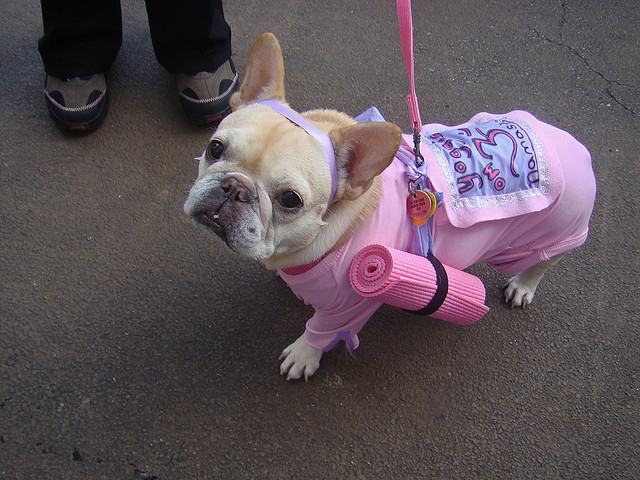
Upward-facing dog might be one of the top 10 yoga poses (after all, it is in the sun salute series), but this pose is not simple or even for many yogic bodies, regardless of their time spent on the mat.
However, the more time I spend shifting my hips from upward-facing dog to the inverted-V of downward-facing dog, the more I realize how complex this posture is.
Because many yogis (and non-yogis) incorrectly assume that the more time we spend inside of a yoga pose, the easier it becomes. While the pose might become more familiar—and possibly physically accessible, too—the shift towards being able to feel micro-movements of the body surely arises the more and more we practice.
I mean, up-dog is actually a pretty strong backbend—and one that takes a long-term relationship to feel out.
I’ve been practicing yoga since I was a teenager, and I’ve had a near-daily vinyasa practice for about nine years—yet I’m still in awe of this pose.
So here are five ways to help us all get more out of our upward-facing dog:
1. Practice child’s pose.
While child’s pose can surely be a great “rest and come back to your breath” pose, it can also help teach proper arm alignment.
Start in child’s pose with arms extended long in front of you and press into the hands as you lift your forearms away from the earth (this is often referred to as the rebound effect).
Next, begin to wrap your triceps in and down, creating the sensations of openness throughout the shoulders and softening in the upper trapezius (at the base of your neck).
From there, internally rotate through the forearms as you also press into the base of your index fingers and thumbs.
Remember this same arm engagement for your upward-facing dog and then…
2. Take this into your downward dog.
Once you’ve begun to access this complicated maneuvering of your arms during child’s pose, start by taking these actions into your down dog.
Once in downward facing dog, bend your knees to focus initially on the upper body.
Stretch and reach through the arms—particularly from the imaginary line running from the tip of your pinkie fingers to the shoulders—and the spine and side-waist muscles without crowding your neck (keep the broad, soft spaciousness of the upper traps you had in child’s pose). Preserve this and straighten the legs.
Recreate the tricep wrap from child’s pose, noticing that your elbow creases will begin to face the top of your mat, and equally feeling the pronation of the forearm—this action of externally rotating your upper arms at your shoulders while still pressing into your inner hand. It’s more challenging than you’d think, so be patient.
One tip is to focus this internal movement of the forearm from above your wrist. If you focus too strongly on perfecting the tricep wrap and then just pressing through your inner hand, too, you might strain the wrists or elbows over time.
Another personal tip from a joint-sensitive yogi: keep your elbows straight but not locked. A micro-bend is okay but, honestly, bending the elbow too much puts strain on that joint once you get into your upward facing dog.
3. Reach through your toes and press down.
The action of your legs is crucial to creating healthy spinal curvature during upward dog.
Think of how you used the press of your hands in your child’s pose to lift energetically up through the forearms—creating lightness and ease and, simultaneously, activity—and then use your legs in a similar fashion to get more lift through the upper spine, so that you don’t dump into the lower back.
Reach actively through the legs like you’re trying to touch the back of your mat and then press down evenly through every toenail, including and especially the pinkie so that you lengthen completely through the lower spine.
4. Slightly tuck your tailbone.
In all backbends, it’s wise to lengthen through your lower spine by engaging your lower abdominals and lengthening the tailbone toward your heels.
It’s kind of like you’re trying to create a forward bending action within your backbend—and to me this is the epitome of yoga—this fusing of opposing forces.
Moreover, you want to feel evenness throughout the entire length of the spine—and this tuck will help.
5. Pay attention to your chin.
Your chin will help you get in touch with the degree of curvature in your neck.
For many bodies, not looking up in upward dog is best—keeping a long, wrinkle-free back of the neck. For all bodies, however, it’s best to not jut out your chin regardless of where you take your gaze and the degree of arc you take to your cervical spine.
I’m not suggesting that you overly tuck your chin during this posture, but do make sure that you’re not jutting it out (this is so common, unfortunately, in most backbends, not just up-dog).
As yoga practitioners, we visit upward dog regularly, and, much like life, the opportunities for true growth and transformation often happen right here, in the spaces and places that we frequently inhabit but become too cozy and familiar with.
And there are so many ways to ceaselessly advance within a posture like up dog, but the most important thing is to never take ourselves or our practices too seriously.
So have fun, play around and feel the true opening and evenness that can accompany a well-refined upward-facing dog—because when we expand and open up in backbends, we’re also opening our hearts up to all that life has to offer.
It’s time to shine—what are we waiting for?
Photo: istolethetv/Flickr.
This article was first published by elephant journal.
The post 5 Ways to Advance & Shine in Upward Dog. first appeared on Jennifer S. White.
]]>The post How to Tell the Difference Between the Quads, Hamstrings & Glutes. first appeared on Jennifer S. White.
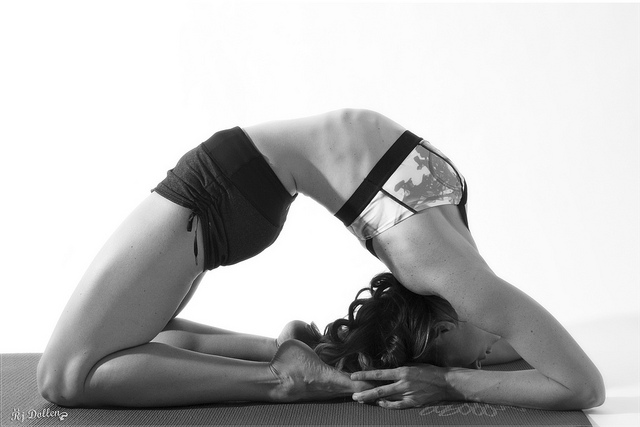
]]>
I recently wrote an article called “10 Things to Stop Doing in Your Yoga Practice.”
In it, I suggested that we stop “overusing your quadriceps.”
In response, a reader left a really wonderful question. She wrote:
Hi Jennifer,
Thank you so much for sharing so passionately those ideas with us yoga teachers and yoga practitioners. I am a brand new yoga teacher and I have a question regarding not overusing the quadriceps.
A lot of people in classes have a hard time distinguishing the use of the gluteal muscles versus the hamstringsand also as you mention overuse their quadriceps. Any suggestions on teaching a balance between these muscles would be really useful and appreciated. Thank you so much.
I replied this:
That’s a tough question to answer in a comment, so if I write a blog on it, I’ll share the link. That said, this is difficult, especially because much of it is experience and trial and error.
One easy way I’ve found for basically everyone to feel the difference between using their quads and their hamstrings (which, as you know, isn’t just one muscle and that alone is a separate conversation) is to take students into warrior one and just have them play with the sensation of pressing into the heel and, without moving the foot, digging backwards on their mat. Try it, and you’ll feel how this activates the hamstrings. Another one is to get them into chair pose and cue them to press into their heels and lift their toes (but I prefer warrior one because most students can stay in it longer and play with it a little bit more).
As far as the glutes versus the hamstrings, in my experience at least, even more seasoned yogis can have difficulty with this mind-body connection. Good poses to work feeling the usage of glutes versus hamstrings are generally backbends and poses of extension (like warrior III) where people tend to overuse the piriformis muscle and under use the hamstrings.
Take them into bridge pose where they can play with this pressing of the heel-engagement of the hamstrings connection and also into poses like baby cobra where people engage their upper glutes when they shouldn’t. (Although I’m of the school that engaging the lower portion of the glutes, kind of by the crease where your butt meets your upper thigh) is ideal, but learning to activate the different gluteal muscles while relaxing others is, again, a very difficult mind-body sensation to feel and activate much less teach.
Needless to say, I decided to write a blog on this because it truly is an important concept to play around with as a yoga practitioner, student and teacher.
Let’s get to work.
Obviously, you’ve hopefully read my brief, imperfect-as-a-blog response above, so I won’t regurgitate what I’ve already shared. However, I do want to expand on a few things.
I’d like to begin by stating that this article is being written more from experience within my own practice than from an anatomy textbook or things you could Google yourself. That said, my experiences might not be yours or, more, it might take a lot of experimentation—as I’ve done—to achieve the recognition of these sensations.
Let’s dig in.
The hamstring muscles run along the backside of the legs and extension involves the straightening and separating of joints. In other words, in our yoga practice a wonderful example of extension involving the backs of the legs is Warrior III.
In Warrior III, we extend the body in one long line, parallel to the ground, while standing on one leg. In both the standing leg and in the extended leg, it’s ideal to work the hamstrings efficiently while not overworking muscles in the gluteal region, such as the aforementioned piriformis. It’s also ideal not to lock the knees and put the joint at risk by falsely thinking you’re engaging your quads.
Here’s what I suggest:
For one, we need to strengthen the glutes.
Weak glute muscles attribute to this overuse of the piriformis muscle, which can ultimately lead to terrible pain and injuries like piriformis syndrome (which involves pain and your sciatic nerve).
Basically, learning to tell the difference between the engagement of the quads, hamstrings and glutes can not only lead to more well-rounded strength within the body, but it can also prevent unnecessary injury and harm.
So now you know that you should pay attention to overworking your piriformis in Warrior III while under-working, well, everything else. And how do you do that?
Let’s discuss backbends next.
Practicing mild backbends is one of the best ways to begin distinguishing between the muscles of the glutes and the legs.
Many teachers will incorrectly cue students to lift up from the quadriceps—I cringe even writing that—rather than properly encouraging to lift from your hamstrings.
Think simply about a backbend—again, in your own experience and not in a textbook manner.
In a backbend, aren’t we contracting the back of our bodies while opening up and stretching the front? Yep, we are. And, as we said right away in our intro, the hamstrings are on the back of the body. So we should be focused primarily on strengthening, toning and intentionally engaging—and lifting up from—the backs of the legs—and from the hamstrings.
First, play around with digging into your heels in bridge pose.
Follow the steps in the above video to get into bridge pose and then experiment with pressing into your heels and, without actually moving your feet, “pushing” your heels away and into your mat. This will help noticeably engage the hamstrings.
Then lengthen the tailbone towards your heels—these two moves coupled together will help us to understand the appropriate lengthening and activation of the quadriceps in most backbending poses. (Which is much more intricate then the ill-used expression “lift up from your quads.”)
Step two: get into Warrior I.
In Warrior I, you’ll also lengthen through your lower back—engaging the lower abdominal muscles—while working the engagement of the hamstrings through the activation of the feet, specifically your heels once again.
In Warrior I, and without actually moving both feet like before, press into the heels and play with moving the heel of your front foot backwards. This pressing and backward motion should fire up the hamstrings in a way that’s pretty obvious to feel.
Then practice lifting up, using the hamstrings—almost like there’s air underneath the front leg while you’re in Warrior I. This will help you get used to strengthening the often weaker backside of the leg rather than being overly reliant on the quads.
From here, if you want to go further into this Warrior I sensation experiment, focus on using the rear leg to press down into the back heel and the outer (pinky-side) portion of the back foot. Use the inner thigh and the back of this rear leg to further root yourself firmly and strongly within your posture without compromising the back knee or overworking the front leg (another common mishap in Warrior I).
(Okay, are you hanging in there? I know this is kind of a lot. Let’s cover one more thing.)
Lastly, let’s get back into a backbend, but this time we’ll do a mild prone (or lying face down) backbend, like baby cobra.
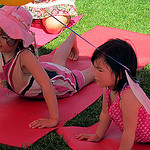
Alright, that’s not exactly baby cobra pose.
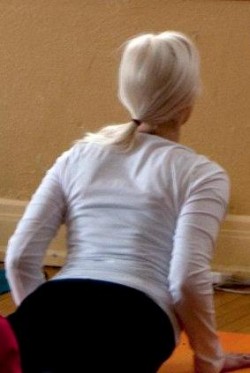
(Yep, that’s a platinum blonde moi in cobra pose.)
Once you’re in your actual baby cobra (with bent elbows that are over the wrists), press into the entire top of the foot, especially the pinky toenails (this will help lengthen through the lower spine). Then notice (just observe) if you’re using your butt muscles to get more extension. If you are, stop.
Like I wrote to our reader earlier, it’s extremely difficult to understand the mind-body connection of differentiation between the glutes and hamstrings—difficult but not impossible.
In the meantime, my suggestion is that you begin with not using the glutes at all in your backbends.
On the one hand, the reason you might engage these muscles is because they will lift you higher into backbends—until you reach the point of flexibility where their hardening becomes a deficit. Arguably, many of us will not get there. Regardless, I have another reason to offer this suggestion.
We already discussed the over-usage of the piriformis muscles and the weakness of other gluteal muscles. In backbends, it’s truly ideal to engage the lower part of the tush—by the crease, by the back of the upper thigh…you know…ahem…the hamstrings—while keeping the upper part of the butt relaxed.
For one, this prevents injuries like those we already mentioned and, for another, it helps to strengthen areas that most of us could use strengthening in (hence our typically weaker glutes and overworked quads).
Honestly, this could be an entirely separate article—this idea of working our various gluteal muscles and leg muscles in backbends—but, for beginning experimentation’s sake, let’s merely start with relaxing your butt completely while trying to exclusively use the back muscles for the lift.
Taking the glutes out of the equation will help ensure that you’re using the muscles that we should be using in many of our prone backbends—the back muscles; and by toning the back muscles properly, you’ll be able to use them more effectively in other poses that can overwork other muscles like the piriformis—as in our already-discussed Warrior III.
Again, please notice I suggested that the ideal backbend differentiates not only between the glutes, thighs and hamstrings but also between the different gluteal muscles. That’s the great thing about our yoga practice—there’s no rush.
It’s just practice. (And maybe we’ll save that concept for another elephant article down the road.)
So here’s to happy practicing.
Namaste.
Photo credit: Author’s own; Ruth Hartnup/Flickr; dollen/Flickr.
This article was first published on elephant journal.
The post How to Tell the Difference Between the Quads, Hamstrings & Glutes. first appeared on Jennifer S. White.
]]>