The post When We Must Be Okay without an Ending. first appeared on Jennifer S. White.
]]>
I didn’t make it to savasana today.
I always finish my yoga practice—even if I clip it short, I still have some form of closure, like child’s pose, savasana or seated meditation.
But today, I just got up. Because it finally settled into my tissues while I was in pigeon pose that sometimes, in life, there is no closure.
The other thing that washed over me in pigeon pose was how much I hate New Year’s Eve. The worst period of my life happened, at one point, during the week in between Christmas and New Year’s, and my body—my physical body—still loathes this time of year.
It doesn’t matter how much emotional or mental healing I’ve tried to do.
It doesn’t matter that, as a yoga practitioner, I’ve also worked at getting this wounded muscle memory far, far away from me; that, regardless, there are still some things that move through us and then stay inside of us forever.
Grief, terror, and tragic human experiences touch us, shake us, and, sometimes, maim us irrevocably.
I was in pigeon pose and I couldn’t see if my left shin was parallel to the top edge of my mat—by this point in my practice, the tears had formed a foggy cloud that altered my vision.
I settled into the pose by feeling my way in; by listening to my leg muscles; by shifting and undulating my spine.
And I let the tears rain down onto my sage green yoga mat.
I let myself release, not only into my yoga posture, but into the internal injury that I carried with me into a new year, despite my best intentions over these last several.
And as I listened to the teacher on the podcast I had been following ask me to lift my heart high in pigeon pose, I ignored him and instead bowed humbly over my leg—spent, tired and broken.
But the funny thing is that as the pools of salty tears collected on the green rubber, and as my heart acknowledged a pain that, seemingly, will never completely go away, I felt honest and I felt fresh for the first time in many months.
I turned off the podcast.
I turned off my little space heater, dutifully heating up the room.
I got up and I walked out, with tears collecting in the smile lines around my lips.
And I let it be okay that my yoga practice just ended, without a thoughtful completion. More, I let it be okay that I still have a knot in the back of my throat made up of un-shed tears and a scar-tissue-covered lump running over my heart.
I’ve decided, too, to be okay with where I am right now—with no real ending; with no perfect savasana.
Photo: Flickr/Felipe Ikehara; Author’s own.
This article was first published by elephant journal.
The post When We Must Be Okay without an Ending. first appeared on Jennifer S. White.
]]>The post 6 Things to Start Doing in your Yoga Practice Now. first appeared on Jennifer S. White.
]]>
The physical practice of yoga has so much to offer.
It gives us time away from our minds and hearts and space to grow and inhabit our present physical states of perfection. More, yoga offers us the gift of experimentation.
With these following suggestions, I offer you the opportunity to try new things within your practice.
Often, we get stuck within a “this is the only way to do a pose” mentality or we become afraid to toe the line of what’s acceptable and proper—and what’s not.
Here’s what I think: if it feels good and it’s healthy for you and for your body, it’s acceptable.
Yoga is a balance and part of that balance means embracing your present circumstance, your present posture and your always changing ability to shift, grow and advance in new—and possibly unlikely—directions.
In short, try something different. Try this:
1. Stop obsessively flexing your foot in pigeon pose and start “barbie footing.”
Catch: this is for the majority of people who have shins that are not parallel to the front edge of the sticky mat; rather your foot is slightly tucked inward and towards your opposite hip-crease.
In this case, flexing your foot likely causes sickling of the ankle, which is never ideal.
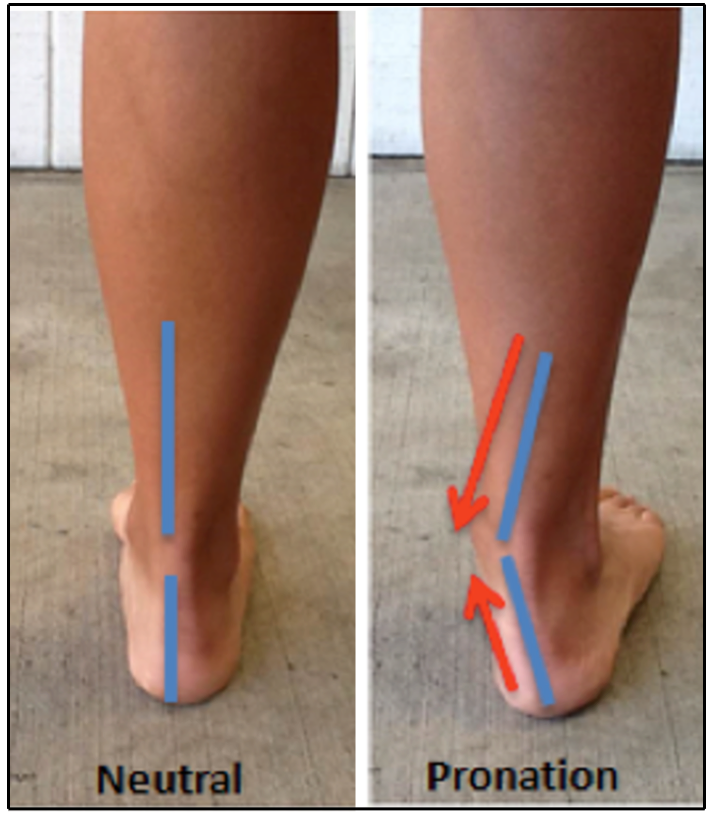
The above images are sickling during standing. In pigeon pose, I’m referring to the shortening the inner ankle—and taking your ankle out of a safe, neutral position.
So, yes, you do want to flex your foot if you’re able to fully get your shin parallel to the top edge of your mat, but if your foot is tucked in, play around with fointing your feet (otherwise known as the barbie foot).
Basically you’re flex/pointing your feet so that you are still slightly flexing (and protecting your knee) but you’re also extending out through the balls of your feet. (Seriously—envision a plastic barbie’s foot and play around with it—and with what feels good to you and your pose.)
2. Eclipsing your heels in downward dog.
As long as we’re on the sickling thing, get into downward facing dog and look at your ankles. Many students are shortening through the inner ankle in this posture as well.
The more common cue is to be told to roll your inner thighs apart and back—this helps lengthen equally through the leg and through both sides of your ankles. However, many students aren’t able to feel this in their bodies yet or, moreover, they think they’re feeling it, but the action isn’t working completely.
Instead, in your down dog, look at your feet and eclipse (or hide) your heels from sight. Notice how this helps equally lengthen through both sides of your ankles. (Then possibly notice how this change in your feet changes what you feel in your legs as well—starting from the ground up.)
3. Coming into extended pigeon pose with engaged legs.
You’ve possibly been told (I hope, at least) to level out your hips (touch your frontal hip points and they should be even) before coming forward (and maybe resting your head on a block or the ground). Additionally, you should experiment with engaging your legs.
Come into pigeon pose and momentarily curl under your back toes (the toes of your extended back leg). Lift your knee off the mat and begin to bring it in and more towards your center line (you know, that roll your inner thigh up and back thing again). Feel your inner thighs hug in towards each other and how this might bring your hips more off of the mat—that’s okay.
Continue to activate through the inner thighs this way and then take your palms flat in front of you (think downward facing dog arms). Next, without moving your hands, create the action of pushing the floor away with your hands as you press the shin of your front leg into the mat and back (again, without actually moving your leg backwards).
From this committed engagement, uncurl your back toes and allow the top of your back foot to rest on the mat and walk forward with your hands any amount that’s comfortable (or stay lifted).
This engagement creates proper pelvic alignment and sets you up for a more effective and safe stretch. (And this is also a huge reason to level out your hips during the posture, as previously mentioned.)
4. Set up for savasana, like you would in any other pose.
Savasana is a pose too. Actually, it’s the most difficult pose. (Read this for more detail on how to properly prepare for the pose of final relaxation.)
If you take the time to create equilibrium throughout your body in savasana (seeking out that same yogic balance that we do in all other asanas), you’ll be significantly more able to find savasana’s ideal relaxation and ease.
5. Breathe.
Okay, in all fairness, you definitely know to be doing this during your yoga practice. I’m nearly positive that you’ve been told something along the lines of if you’re not breathing, then it’s not yoga. And yet at one point or another, nearly all of us are guilty of going too deeply into a pose and at least hindering our best breath or, more likely still, we’ve encountered colds, sinus issues, etc, etc that prevent us from working our ujjayi breath at all.
Let me tell you, coming back to my fullest practice after sinusitis, bronchitis and sinus surgery has reminded me that it doesn’t matter how long my hamstrings are or how strong my core is if I cannot breathe during the process.
So, please, all I ask is that you continually check in with your breath not just throughout your practice but also consistently ask yourself if your breath or your poses have become the most important factor as you move—and breathe.
6. Press into your inner hand while transitioning from chaturanga (low plank) to upward facing dog.
This pose is similar to a triceps push-up—like it or not, that’s the reality. However, when you move from your low plank, or chaturanga—and remember you can drop your knees—press into your inner hand (the base of your thumbs and index fingers) while lifting up into up-dog.
Much like your feet helping to properly engage your legs, your hand placement helps to properly engage the muscles of your shoulder girdle. Without getting into too much detail (in this blog, at least), try it and see what happens. I’m confident you’ll like the results.
I have a few other things that I wanted to add to this list.
I wanted to talk about your hips in Warrior II and more about downward facing dog as well as your shoulder heads during chaturanga and arm balancing—but I don’t want to overwhelm.
Instead, my intention is to create excitement for you and for the many new and fresh things that you can continually be changing up within your practice. There’s no reason to ever become bored on your mat and there are always ways that we can continue to get in touch with micro mind-body movements in order to become healthier and happier within our poses.
So play around. Yeah, do that. Actually, if you never stop doing that, then you’re probably doing just fine.
Photos: Author’s own; Wiki Commons;
This article was first published by elephant journal.
The post 6 Things to Start Doing in your Yoga Practice Now. first appeared on Jennifer S. White.
]]>