The post The Caged Girls: The Key. first appeared on Jennifer S. White.
]]>Part Five: The Key (Chapters 13 through 17).
Chapter 13
She sits typing rhythmically in recycled plastic yoga leggings that are softer than satiny silk.
Unicorns run down the backs of her legs and the vibrant coral of the fabric’s magical desert-sunset backdrop goes completely with her fluorescent pink top.
She knows that she looks ridiculous to probably most people, but she doesn’t care.
Her new good luck charm—a gilded unicorn on a gold chain, adorned with a faceted and meaningful peach gem—rests below her throat and above her quaking heart.
Her fingers feel clumsy today—simultaneously sleepy and too rested. She glances quickly at the clock, notes the time and continues to work; wearing only her new gold necklace and wedding rings, the deep sapphire blue band sparkles as her fingers dance across her laptop keyboard.
The words tumble out freely—the releasing of long-stagnating water—and she contemplates her outright declaration that this will be the year of the unicorn—the year she’ll believe in magic.
Chapter 14
Her daughter now owns a matching pair of recycled plastic, unicorn-backed pants.
She sits on her mother’s lap, so that their thighs can touch and she can point to where their knees are cloaked in the same soft material.
She doesn’t yet understand the magic of the unicorn or what her new clothing symbolizes, but she feels deeply that they are special—if only because they allow her to match her mama.
But she knows that magic is real.
She sees the way that snow drifts down in huge whirls from their rooftop; the way the light catches on an icicle outside her bedroom window; how a person can hold the entire universe inside the palm of her tiny, closed hand—even if that hand is still much bigger than your own.
It intrigues, also, the older woman that people can be so small and inconsequential and yet so correspondingly huge.
She feels the way that she compares her popularity to others on base social network sites and the few friends that she has by how rarely they call when she needs. It disturbs her—these things playing any level of significance in her day’s thoughts—because, as she sets her phone aside, she sees plainly the way the younger girl looks at her—like the world would stop its turning if for one moment her mother’s small star set.
She closes the pieces of plastic that make up her laptop—where her fingers twist stories and her mind enters the tangible—and she sits motionless for a beat or two, so that the buzz of her words might settle and dissipate into the air that she and her daughter breathe.
Chapter 15
I can’t believe that I write about my eating disordered past.
It doesn’t shame me or feel lowly, but that girl feels like a ghost and nothing at all like me.
But then I place myself in time—back when she lived and thrived and flourished—and I recognize how ill I was and how this girl was definitely me, however removed from her I am currently.
And then I walk into the yoga studio and I hear women talking about their backsides as they scan them in the lengthwise mirror or a friend tells me how round she is in the middle or, worse yet, I see small children already noticing how and where their bodies differentiate from their peers.
I know that I can’t keep my daughter from this body assessment, no matter how hard I try—a cage awaits her, and it’s not as far down our road as I often like to think.
I can’t keep her safe from herself forever, but I can tell her my secret—the story of my own disease and how I learned to love myself after a long and arduous, up-hill journey and I can do something that most of us do not: I can let her in.
It’s definitely easier to push people away when life grows difficult, and I’m absolutely guilty of this behavior, even when what I need most is a gentle hug or a word of tender kindness from someone who knows me well; it’s a protective coping skill that’s developed as we learn how much we can tolerate and what makes us want to shut down, and it’s challenging times like these—when we fear we have broken irreparably—that a cage can actually become a welcome home.
Still, having anorexia is an extremely unsuccessful way of reclaiming this comfort of control.
At first, the hunger pangs that go ignored are empowering and the mind conditioning—not unlike a long-distance runner—becomes a source of pride. The inherent flaw with this plan, though, is that the downward spiral of physical weakness and the dependency on the disease itself both negate any semblance of control that the victim can possibly maintain (which usually isn’t much anyways).
There’s a reason, too, that many women never recover.
For one, our society has a horrible way of giving silent props to thin women, even if it took starvation to get there. At the same time, we condemn this unhealthy behavior, and this blatant double-standard does not go unnoticed—and it’s confusing, especially to young, forming girls.
Fashion models, actresses and gorgeous singers are gold-worthy goddesses, and the assumption is often that they are eating disordered in some way—they must be—and then, regardless, we hold them high on (tipsy) pedestals where our little girls look up at them in idol worship.
And how disturbing is that? Essentially, we’re promoting each round of new females to battle their bodies; to live in cages with limited stores of food and copious amounts of self-conscious critiques.
And, yes, we can argue that not every woman becomes anorexic or even eating disordered at all—and, surely, there are small amounts of truth buried there—but we can’t ignore how many of our daughters and sisters and mothers and lovers judge themselves next to unfair and unreachable standards. More, we can’t pretend that somewhere—every day—girls aren’t climbing into cages that they might never be able leave.
Chapter 16.
I would wake up in the morning before school and immediately stand in front of the bathroom mirror.
I would lift my lavender and white striped pajama top and look at my concave navel and the slight protrusion of my ribs.
Later, as I walked through the school corridors, I would look down at white tennis shoes as other girls passed by. I was a good girl who did my homework and didn’t let boys touch her underneath her shirt.
I sat down at the long, faux-wood table in front of a clunky, old computer and the boy next to me remarked that my glasses looked like they didn’t fit me anymore and that my face had shrunk over the summer and was I okay?
It struck me as fascinating that this boy with the slightly naughty reputation would be one of the only people to ever ask that question—to my face, at least.
And then I was sitting on the bench in the women’s locker room of the strip-mall gym that I frequented early in the morning, before my classes began at the university. The sun was barely up and the locker room was dim, bordering on dark.
A woman I didn’t recognize in the least asked me, almost frantically, if I was okay. She wasn’t able to walk past my gaunt frame lifting weights or working in the cardio room, the way that the others could and did.
I stepped on the scale before I left—92 pounds.
I walked down the long, underground school hallway to my mineralogy class and my favorite professor asked how I’d keep warm when it really got cold—I was wearing a thick, scratchy wool sweater and it was barely October.
I walked into the bathroom after class; the one where few girls entered because not many were in the geology building in the first place.
I bent at the waist and looked underneath the two stalls for feet and, seeing none, lifted my ribbed cotton shirt; examining my concave navel and protruding ribs. The girl who looked back at me was empty; hollow. Her eyes didn’t sparkle and her smile wasn’t there either. Her hair wasn’t shiny and her stomach had a thin coating of downy hair.
Who are you? I wanted to ask out loud—I wanted to shout. What have you done with the real me?
I pulled my shirt down and picked up my book-weighted backpack. I pulled with all of my 92 pounds on the metal handle of the heavy bathroom door and returned down the empty corridor to my chemistry class.
I wondered absently if this was the real me, in that bathroom mirror, and a shiver of terror ran from the back of my head to my empty stomach, creating goose-flesh on my almost skeletal arms.
Chapter 17.
My scrawny limbs scratch and the flesh tears as I reach desperately through the metal bars.
I can see white-blinding light streaming in through thin, parallel slats.
I went out to dinner with my boyfriend. He wants desperately for me to just eat; to be well; to not be slowly killing myself while pretending nothing’s happening.
I’m over 21, but I don’t drink. I sit down across from him at the round, alabaster cloth-covered table and order a glass of rosé. My first sip tastes bitter—like slightly tart juice. I decide to swallow it, not because I really care for the alcohol content, but because I hope that the wine will be my spoonful of sugar that helps the medicine go down.
It works and I regularly drink wine with my meals.
We order deep fried pickles served with a homemade, creamy white sauce, the consistency of which disturbs me on a deep level. I ask the waitress to bring the veggie sampler as my meal—it’s a plate of raw vegetables.
We walk home after dinner, to our cozy, we’re-in-love-and-this-is-our-first-ever apartment.
Inside I slip off my jacket and he touches my cheek with his work-toughened fingers. He lightly kisses me and pulls me towards our sparse bedroom, down the long, dark, narrow hallway. I’m needing his body in a way that’s absolutely more than physical—I’m needing him to love me.
We spend innumerable nights alternately studying, watching Seinfeld and, basically, growing up together in our second-floor apartment in a college town plopped down somewhere in a Midwestern cornfield.
We fall in love and we, sometimes, fall out of love to. (I’ve learned that the secret to a relationship’s survival is not falling out of love at the same time.)
Of course, we never truly fall out of love, but we do fall out of accord with each other—especially when I’m riddled with my disease. It affects every aspect of my being and it takes my personality away. The starvation doesn’t just hit my taut-skin-over-bone body, it dissolves the very center of myself to an almost empty state.
I watch acids work in similar fashions from where I sit, perched high on my black leather stool in chemistry class. I also watch liquids change color—periodically transforming completely—with the addition of just one small ingredient.
I begin to believe in magic—and not the kind that leads other college kids to purchase corny metal daggers and velveteen, hooded cloaks—but the kind where anything is possible—where I can be free.
I feel glaring light hitting my face in even, thin slants. I close my eyes and hug my thighs up to my chest—curling into a ball with the smallest surface area imaginable—and when I reopen them, I see a figure standing over me—arms outstretched, work-toughened palms wide and face up.
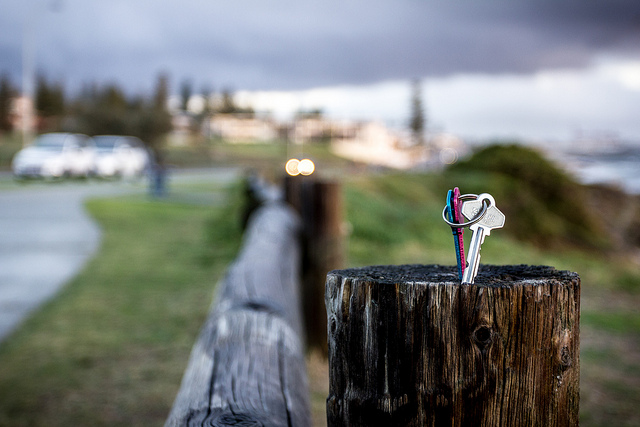
I blink repeatedly—being so unused to bright light and the juxtaposition of his dark shadow with it—and I hear the tinny clink of metal landing hard on metal. When I look over, to where the sound came from, all I see is a worn, thick key.
Photo credits: Daniel Lee/Flickr.
The post The Caged Girls: The Key. first appeared on Jennifer S. White.
]]>The post 10 Things You Should Do Every Day. first appeared on Jennifer S. White.
]]>
Daily Mini-Resolutions
I don’t believe in New Year’s resolutions. Why? Because I think we should be working on self-improvement and overall life satisfaction on a regular basis, rather than on some arbitrary date.
Having said that—in re-thinking my anti-resolution stance—I recently realized that I practice mini-resolutions every single day.
Here is a list of 10 of those things.
1. Open your heart.
Don’t let life make you cold and callous. Remember that to truly enjoy life you have to be open to the reality that sometimes it hurts too. Keep opening your heart to love.
2. Give sincere compliments.
I’ve blogged before about how our society is so critical that people often don’t even know how to receive compliments. I’m not suggesting you go around throwing out so many compliments that they become meaningless, but sometimes letting someone know that you notice them in a positive way is exactly what that person needed—and that positivity will come back to you.
3. Put effort into life.
My husband often says that people have a sense of entitlement, that they think they’re owed success or happiness. Guess what? You’re not. The reality is that life isn’t fair; happiness often takes working at having a positive outlook and mindset and worthwhile success comes from effort. However, I truly believe that God, the universe, or whatever you believe in, helps people that help themselves.
4. Be honest, but not hurtful.
Honesty should be your only policy, but not when this honesty serves to make you feel better while hurting someone else. Learn when to be open and forthright—and when to keep your yapper shut.
5. Sing.
Yes, sing. Singing clears our energy and brings lightness to our hearts. It really doesn’t matter if you’re a good singer. Just close the door, turn on your favorite song and belt out a tune—I promise you’ll feel invigorated.
6. Play.
Every single day you should be doing something fun. Even if you have the craziest day at work or your kids are sick, there’s always one minute to joke and laugh with your spouse, to read a few pages of an inspiring book or to simply play along with your children (trust me, kids know how to have fun). Even making dinner can be enjoyable—if you have the right attitude.
7. Drink water.
I love water—a lot. If you don’t like water, too bad, drink it anyway.
8. Quit reading the news.
All right, I’m certainly not saying that we should become uneducated drones, but how often do you read unnecessarily damaging headlines—about depressing things that you can’t change or that don’t really affect you—and you feel like crap afterwards? So stop. Put down your phone or the TV remote and, I don’t know, sing a song instead.
9. Hug.
Hugging is so underrated. Hugs help you become happy and relaxed almost instantly. Too often the people that we love become ordinary faces that we don’t spend enough time loving in basic human ways, like hugging.
10. Forgive.
Almost every day presents us with challenging people or situations. These people and opportunities are put in our way because they serve to make us better people—if we allow it. So stop carrying old baggage around, and open yourself to the notion that every minute provides you the chance to start again—regardless of the date. Let yourself move forward—without the weight of burdens that don’t serve your best self.
While I don’t believe in New Year’s resolutions, I definitely do believe that every day can bring us closer to our highest, happiest selves; so consider trying these 10 small things on a regular basis—because it’s these little steps that get you where you want to be.
If you like this article, check out:
The Best Day of Your Life: A Guide to Transforming the Ordinary Into the Extraordinary.
Photo: John Templeton/Flickr.
This article was first published on elephant journal.
The post 10 Things You Should Do Every Day. first appeared on Jennifer S. White.
]]>