The post Why Being an Empath Isn’t Always a Good Thing. first appeared on Jennifer S. White.
]]>
There’s a new “it” word that seems to be everywhere lately.
That word is “empath.”
An empath is someone who can feel the emotional and mental state of someone else—an empath isn’t entirely separate from the idea of empathy for others.
Yet another “it” word right now is “narcissist.” Narcissists, on the other hand, have an inability to feel true empathy for others, but it’s not just a word to throw around—it’s a serious psychological personality disorder.
Empaths and narcissists frequently attract—and are fused together conversationally—because of an empath’s overly empathetic nature and a narcissist’s pathology to be dominant and shown excessive attention—and they often continue this cycle of raising and creating more empaths and more narcissists.
But anyone who is infatuated with being empathetic would possibly be better off looking at their own family history and becoming interested in stopping this often damaging cycle of breeding, rather than feeling empowered by their empathetic nature.
This isn’t to say that we shouldn’t be proud of our personalities and personal abilities—having the desire to empathize with other people can be a beautiful thing.
Yet, there’s a point where this current “it” topic is not something to go around bragging about and aspiring to be—because, again, these can be truly injurious personality disorders and personal liabilities that attract us to the wrong people, be it romantically or not.
My daughter and I were watching this kids’ show Caillou the other day.
Let it be officially know that I cannot stand this show. I’ll give you one reason why.
This particular episode wasn’t unusual in depicting the main character, a four-year-old boy named Caillou, as empathetic—I will not go so far as to call his character an empath right now.
Anyways, Caillou encountered a boy at preschool who, after multiple attempts, had no desire to be Caillou’s friend. So Caillou goes home and talks to his family, and his mom tells him that he’s a nice person and nice people just keep on trying to make friends.
Just keep trying to make him like you, Caillou!
Doh! My hand slaps my forehead as my daughter attentively watches this show.
I’m sitting there thinking how this would have been a great opportunity to display to small children that while it is important to be nice, regardless of how others treat us, that we, for one, cannot get everyone to like us no matter what we do and, for another, we don’t need to be friends with everyone.
But, no, this has become a discussion with my daughter about how this animated series on our television screen—that she seems to adore—is, in my estimation, way off base in its lesson of the day.
Back to being an empath.
We can care for and empathize with others without regularly going over and beyond our own needs for care and empathy—this is what healthy emotional relationships—and healthy boundaries—look like.
They don’t look like trying to read others’ thoughts, or anticipating what someone else is going to say. They don’t look like placing our general happiness into the hands of another person. (And this type of behavior can and should be annoying and clingy to someone who is healthy and doesn’t pathologically need to always be the center of attention—cough, cough—we’re all looking at you, narcissist.)
While encouraging unity among people, love for other people and a desire to connect with others is something positive, attempting to nourish and procreate an empath personality without considering healthy personal boundaries is not.
People can, and do, have an in-born nature of empathy, but this can be encouraged healthfully in the form of good personal boundaries, or it can be nurtured into codependency.
Yet being co-dependent and a true empath are not the same.
Codependency is a dysfunctional relationship of enabling. Empathy, though, is the ability to feel for and understand another individual through the frame-work of their own experience—and this is critical: empathy is not a projection of our feelings and thoughts onto others.
But the debate of whether real empathy is healthy and positive—or not—comes into play when we really dig into the reason for empathy.
Empathy can surely be altruistic and, arguably, often is, but it’s definitely possible for empathy to be as ego-fueled as narcissism. In this particular situation, being an empath is problematic—and not something to idealize or aspire towards.
A friend and I were talking about this recently and she said that “empath is this decade’s “sensitive skin”—everyone wants to have it, but the people romanticizing it don’t realize how difficult it can be.”
Because an empathetic nature can be genuinely nurturing and beautiful, but, much like sensitive skin, it can be equally disastrous if not taken care of.
Still, I’m not a psychologist. I’m not here to give precise advice to either empaths or narcissists or to be the front-runner in this important discussion. That said, a lot of writers are hopping onto this empath band-wagon—and romanticizing this empath character without also talking about the often unhealthy reality of life as or with one.
So, yes, let’s talk about empaths.
Let’s talk about narcissists, too.
After all, this should only be the beginning of this conversation.
Because let’s not forget that healthy emotional love does not have to involve needing to plug into others at the expense of remaining an independent source of light and love.
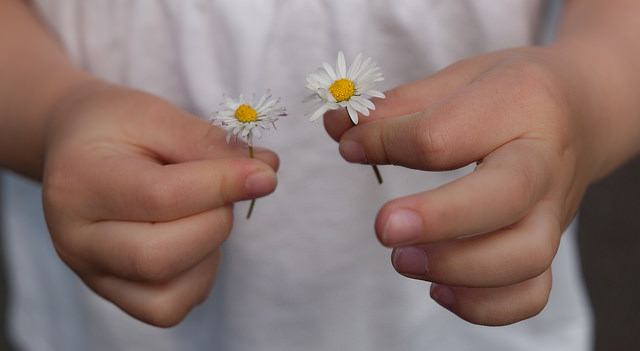
Photo: Flickr/Holding two daisies.
The post Why Being an Empath Isn’t Always a Good Thing. first appeared on Jennifer S. White.
]]>The post Throwing Away “I’m Sorry” & Teaching Empathy. first appeared on Jennifer S. White.
]]>
Teaching our kids empathy instead of meaningless “I’m sorries.”
These days, it seems that I meet more and more narcissists.
While I’m not a psychologist, it is commonly believed that a true narcissist doesn’t have the ability to feel empathy for other people and, more, that this personality disorder is largely connected with how a child was raised.
That said, I’m sure all of us have at least one friend who throws around “I’m sorries” for anything and everything. Not only can this be annoying, it also makes these words meaningless when over-used (without even mentioning the self-esteem and mindset of the frequent “I’m sorrier.”)
And, in this day and age of raising my children with social media and selfies galore, as a parent, I’m even more concerned with teaching my children how to really feel emotions—both their own and another’s.
The idea of teaching empathy to my daughter became a reality for me when she was a little over two and a friend, who’s a Montessori teacher, and I were having a playdate with our children. She overheard me tell my daughter to say “I’m sorry” to her playmate. Kindly, my friend intercepted, and encouraged me to instead teach my daughter to ask, “Are you okay?”
Teaching a small child to ask someone, “Are you okay?” reinforces why we say the words, “I’m sorry” in the first place. Eventually, these traditionally apologetic words will come naturally and, when they do, there will be much more understanding of why they’re used at all.
Another reason to stop teaching tiny kids to reactively say “I’m sorry” is because this does actually teach our children something, albeit not what we’re intending to; it teaches a child to feel guilt.
But personal guilt is not the same as empathy. While guilt and remorse certainly do, and sometimes should, occur within a situation that bears the need to apologize, these emotions are not the primary things we should have to teach our children.
It’s easy to think that empathy is unteachable, but I don’t see this as the case. Again, look at personality disorders connected with empathy and often times how a child was brought up is a huge part of the discussion—and underlying problem.
I recently read a thought-provoking article in The Guardian on the merits of talk therapy with trauma, and how various cultures around the world perceive talking about what caused the trauma as alternately helpful and harmful. Yet, in our Western mindset, we are raised to see talk therapy as one of the best (and only) real ways to move past a trauma and into health.
In other words, emotions and experiences do not always translate identically between different cultures.
As someone who studied sociology in college, the idea of ethnocentric thinking is of the utmost importance. We cannot fully understand or appreciate other cultures and people if we are always seeing the world through our own eyes—and this is what empathy is or, more accurately, isn’t.
True empathy is the ability to understand a person’s feelings through their eyes and not our own—the figurative “put yourself in her shoes” situation—and this begins at a very young age.
So, as a mindful parent and a tender human being, it’s crucial to me that I do the best I can to teach my daughter to respect and care for other individuals enough to try to place ourselves in their shoes; to feel what they are feeling through the scope of their own reality. Additionally, it’s important that I teach my daughter to care about her own feelings as well.
Women and girls everywhere are still more susceptible to be taught servitude and placing themselves last. I want my child to know that her feelings matter too, and that casually throwing around an “I’m sorry” both detracts from the value of empathy for other people and it isn’t ideal for her own confidence either.
And I’ve also lately read several articles debating whether or not to teach children to say “I’m sorry,” but I’ve rarely (okay, never) seen a discussion like this brought up: that the most important aspect of this debate is that we can teach children why they are saying “I’m sorry.”
While I’m still in the throes of child-rearing and certainly cannot pretend to be a grand success in this paramount matter, I do think that, as a society, we need to address what we can do to better promote our shared connectedness and concern for one another. After all, a society cannot exist without individuals, just like an individual cannot exist without society.
“He who is unable to live in society, or who has no need because he is sufficient for himself, must be either a beast or a god.” ~Aristotle
Photos: Author’s own.
The post Throwing Away “I’m Sorry” & Teaching Empathy. first appeared on Jennifer S. White.
]]>The post How to Know If You’re an Empath. {Video} first appeared on Jennifer S. White.
]]>
I love this—simple and to the point.
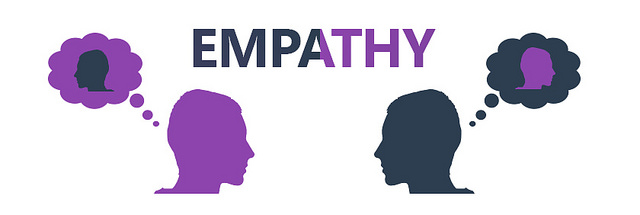
I don’t want to give this test away, so test your empathy in a matter of seconds, starting….now!
Photo: Sean MacEntee/Flickr; Flickr/Geraint Rowland.
The post How to Know If You’re an Empath. {Video} first appeared on Jennifer S. White.
]]>